
John Wiley & Sons · 2006
Treasury Risk Management: A Guide to Managing Market and Credit Risk
Level · Intermediate
Editorial summary
Treasury Risk Management: A Guide to Managing Market and Credit Risk is a pivotal resource for professionals engaged in treasury and risk management. The book stands out on our shelf as a thorough exploration of risk management practices specifically tailored for treasury functions, distinguishing it from more general risk management texts. The authors, Michel Crouhy and colleagues, delve into the core aspects of market and credit risk, offering frameworks and strategies that are immediately applicable in real-world scenarios.
The text is structured to guide readers through essential concepts, including the identification, measurement, and mitigation of risks faced by treasury departments. It covers various methodologies, such as Value at Risk (VaR) and stress testing, while also addressing regulatory considerations that impact treasury operations. This makes it particularly relevant for professionals looking to enhance their understanding of risk management tools and their practical applications.
Readers can expect to engage with intermediate-level mathematical concepts and quantitative methods, which are necessary for effective risk analysis and decision-making. The book's focus on both market and credit risk ensures that treasurers and risk managers can develop a holistic view of their risk exposure, facilitating better strategic planning and risk mitigation.
Treasury teams will find this guide invaluable for establishing risk limits, pricing strategies, and compliance frameworks. It serves as a practical reference for implementing risk management policies that align with organisational objectives, ultimately supporting informed decision-making in treasury operations.
While the book is comprehensive, it is important to note that some readers may find the depth of mathematical analysis challenging if they lack a strong quantitative background. However, the structured approach and clear explanations help bridge this gap for those willing to engage with the material.
About this book
Treasury Risk Management: A Guide to Managing Market and Credit Risk is an extensive resource designed for professionals in treasury and risk management. The book is organised into coherent sections that systematically address the various dimensions of market and credit risk, providing a thorough grounding in the subject matter. Readers will find that the text not only outlines theoretical concepts but also integrates practical applications, making it suitable for immediate implementation in treasury functions.
The core technical ideas presented in the book include risk identification, measurement, and mitigation strategies. The authors introduce key methodologies such as Value at Risk (VaR), scenario analysis, and stress testing, which are essential for understanding and managing risk exposure. Additionally, the book discusses the regulatory landscape that impacts treasury operations, ensuring that readers are well-versed in compliance requirements and best practices.
Prerequisites for readers include a foundational understanding of financial instruments and basic quantitative skills, as the book employs intermediate-level mathematics to explain risk management techniques. By engaging with the content, readers can expect to gain competencies in assessing risk profiles, implementing risk management frameworks, and developing strategies to mitigate potential losses.
Overall, this guide equips treasury professionals with the knowledge and tools necessary to navigate the complexities of market and credit risk. It serves as a critical reference for enhancing risk management practices and fostering a culture of risk awareness within organisations.
Why it matters
Effective treasury risk management is crucial for maintaining financial stability and compliance within organisations. This guide provides the necessary frameworks and methodologies that enable treasurers and risk managers to set risk limits, optimise pricing strategies, and ensure adherence to regulatory standards, thereby directly impacting the organisation's financial health and operational efficiency.
Best for
This book is best suited for treasurers and risk managers seeking to deepen their understanding of market and credit risk management. It is also valuable for financial analysts and compliance officers involved in treasury operations.
Not ideal for
It may not be ideal for beginners in finance who lack a foundational understanding of risk management concepts or for those seeking a purely theoretical exploration without practical applications.
Key themes
treasury|risk-management|market-risk|credit-risk|regulatory-compliance|quantitative-methods|financial-instruments|risk-mitigation|value-at-risk|stress-testing
Strengths
One of the key strengths of this book is its comprehensive coverage of both market and credit risk, making it a holistic resource for treasury professionals. The structured approach allows readers to progressively build their knowledge, while the practical examples and methodologies provided enhance real-world applicability. The integration of regulatory considerations further enriches the content, ensuring that readers are well-prepared to navigate the complexities of compliance in treasury operations.
Limitations
A potential limitation of the book is its intermediate reading level, which may pose challenges for those without a solid foundation in quantitative finance. While the authors strive to explain complex concepts clearly, readers who are not familiar with mathematical techniques may find certain sections demanding. Additionally, the focus on practical applications may leave some theoretical aspects underexplored, which could be a drawback for those seeking an in-depth academic analysis.
Related books
Shared topics with this title.
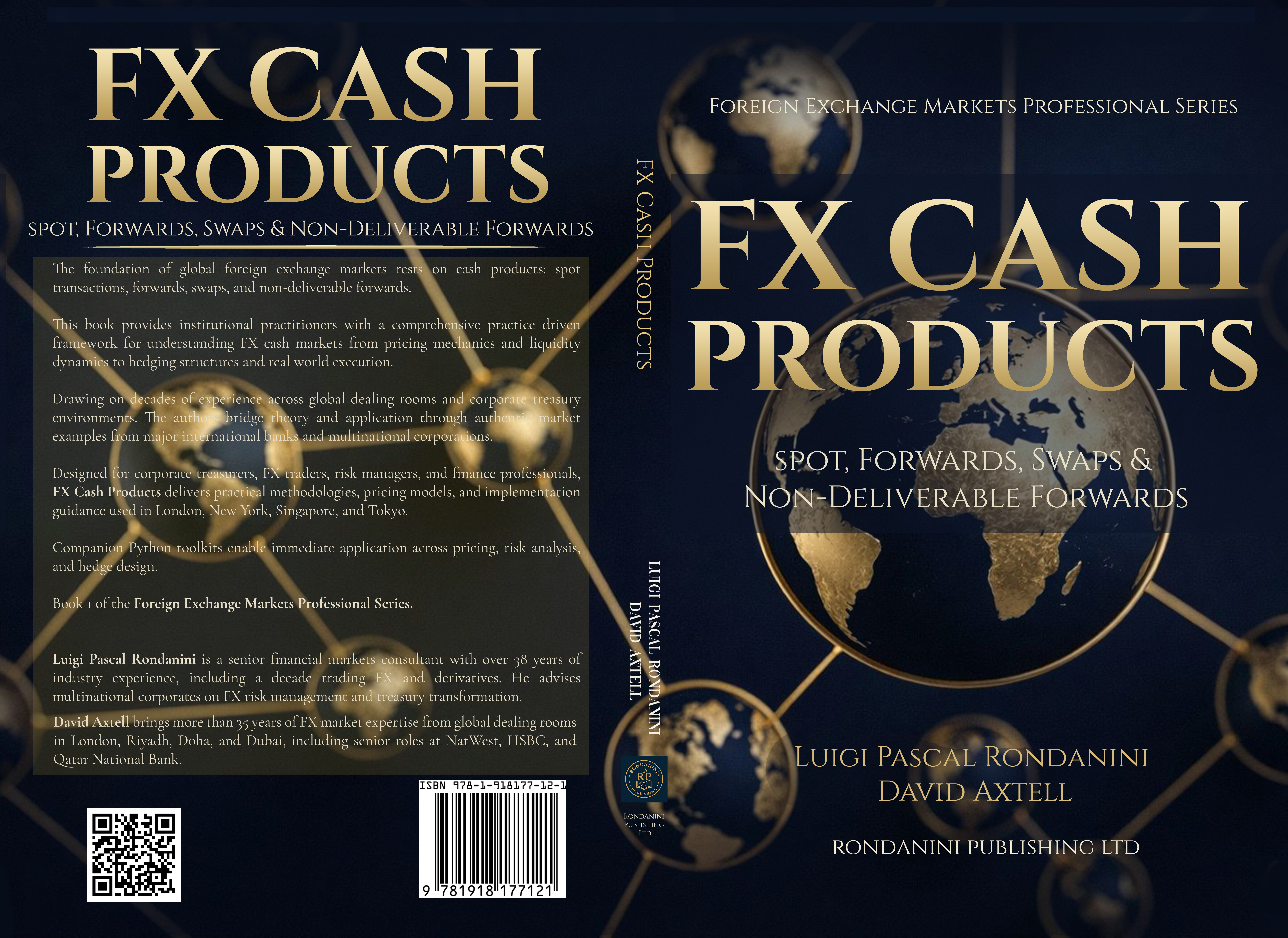
FX Cash Products: Spot, Forwards, Swaps & Non-Deliverable Forwards
Practitioner guide for treasury and markets
Luigi Pascal Rondanini · David Axtell · 2026 · Rondanini
Spot, forwards, swaps, and NDFs for corporate treasurers, traders, and risk managers—operations-first, institutionally framed.
- FX
- Treasury
- Risk management

Modern Computational Finance
Scripting for Derivatives and xVA
Antoine Savine · Jesper Andreasen · 2021 · John Wiley & Sons
Second volume: building professional derivative scripting systems—cash-flow representation, branching, American Monte Carlo hooks, and how scripting supports xVA-style portfolio interrogation. Written for quant devs and library architects who must ship maintainable payoff DSLs.
- Derivatives
- Quantitative finance
- Risk management

Options, Futures, and Other Derivatives
Global edition
John C. Hull · 2021 · Pearson
The standard graduate-level derivatives text.
- Derivatives
- Risk management
- Quantitative finance

Cybersecurity in Financial Services: Frameworks and Best Practices
Kevin Mandia · 2018 · John Wiley & Sons
This comprehensive guide addresses the critical intersection of cybersecurity and financial services, offering frameworks and best practices essential for risk managers and technology professionals. It outlines strategies to mitigate risks associated with cyber threats in the financial sector.
- Risk management
- Technology
- Regulation & compliance