
John Wiley & Sons · 2018
Modern Computational Finance
AAD and Parallel Simulations
Antoine Savine · Leif B. G. Andersen
Level · Institutional / advanced
Editorial summary
This volume belongs on the quantitative implementation shelf next to classical derivatives mathematics, but its subject is the engineering layer that makes large-scale risk run: Algorithmic Adjoint Differentiation (AAD), simulation design, and parallelism. Savine and Andersen write from backgrounds in major dealer quant and systems work; the book’s value is in turning adjoint methods from conference slides into a disciplined development programme rather than a single toy example.
Readers work through how sensitivities can be extracted from pricing code with complexity characteristics suited to enterprise portfolios, where bumping every risk factor is economically and computationally prohibitive. The narrative repeatedly ties back to Monte Carlo and simulation-heavy payoffs, where AAD’s strengths (and footguns) are most visible in production.
The mathematical level is postgraduate quant: readers should be fluent in stochastic calculus at a working level, comfortable reading C++-oriented pseudocode, and familiar with basic numerical analysis. The prose is still more “quant desk + quant dev” than pure probability theory, but this is not an entry-level book.
Risk management, model validation, and front-office quant teams treating XVA, CCR, or desk-wide Greeks as batch problems will find the framing directly relevant: the same computational patterns underpin regulatory stress stacks and intraday risk refreshes. The book helps align quant research, library owners, and IT on why adjoints beat naive bumping when architectures are clean.
Honest scope boundary: the title is not a substitute for a full Monte Carlo theory treatise or a GPU hardware manual; it assumes readers can already price vanilla and exotic instruments at a basic implementation level and now need scalable risk. Where firm-specific scripting languages appear in other Savine volumes, this book stays closer to the core AAD/simulation curriculum.
About this book
The structure moves from foundational adjoint concepts through application patterns in Monte Carlo, including pathwise and likelihood-ratio ideas where relevant, then into software architecture concerns: separating concerns so risk can be extracted without turning pricing code into an unmaintainable tangle. Parallelism is treated as a first-class design constraint, reflecting modern batch stacks rather than single-threaded prototypes.
Case studies and discussions emphasise credit and rates-style simulation workloads common in bank balance-sheet contexts, without pretending to catalogue every asset class. The Andersen co-authorship signals attention to industry-grade calibration and simulation practice rather than purely academic toy models.
Prerequisites include solid C++ or equivalent systems literacy, prior exposure to Monte Carlo pricing, and comfort reading dense technical prose. Teams planning a library rebuild (FRTB-style stacks, XVA batch, or desk-wide AAD rollouts) can use the book to align vocabulary between quants and core library engineers.
Competency gained is architectural: readers should finish able to critique an in-house pricing stack’s differentiability, spot where naive bumping will fail at scale, and participate credibly in vendor vs build decisions for risk engines.
Why it matters
Regulatory and commercial pressure pushed banks toward portfolio-level sensitivities and repeated revaluation. AAD is no longer an academic curiosity; it is infrastructure. A serious derivatives catalogue should name a modern reference that connects adjoints to Monte Carlo at production scale, not only to toy Black–Scholes Greeks.
Best for
Front-office and XVA quants implementing or refactoring risk engines; quantitative developers owning pricing libraries; model-validation teams reviewing sensitivity methodologies; senior MSc/PhD entrants joining a rates or credit analytics stack who need the standard vocabulary for adjoints and parallel simulation.
Not ideal for
Readers without programming maturity or stochastic-calculus comfort—start with Baxter–Rennie, Glasserman, or a solid MSc course first. Desks seeking trading psychology or macro narratives will find the book impenetrable. Small buy-side shops without batch Greek needs may see limited immediate return unless they are building proprietary risk tech.
Key themes
algorithmic-adjoint-differentiation|monte-carlo|parallel-simulation|sensitivities|quant-libraries|c-plus-plus-implementation|risk-engines|institutional-pricing|computational-finance|model-validation
Strengths
Practitioner authorship anchors the book in deliverable systems, not abstract optimal-control exercises. The AAD + Monte Carlo pairing matches how modern bank stacks actually spend CPU. The text is unusually explicit about software structure, which helps library owners argue for refactors with evidence. As the first volume in Savine’s series, it sets up the scripting and xVA companion cleanly.
Limitations
Dense and implementation-heavy: slow going without code alongside. Not a gentle on-ramp for career switchers. Hardware evolution (GPUs, vendor SDKs) means some deployment detail ages; readers must map patterns to current toolchains. It does not replace domain-specific credit or rates modelling texts—it assumes payoff-level pricing already exists.
Related books
Shared topics with this title.
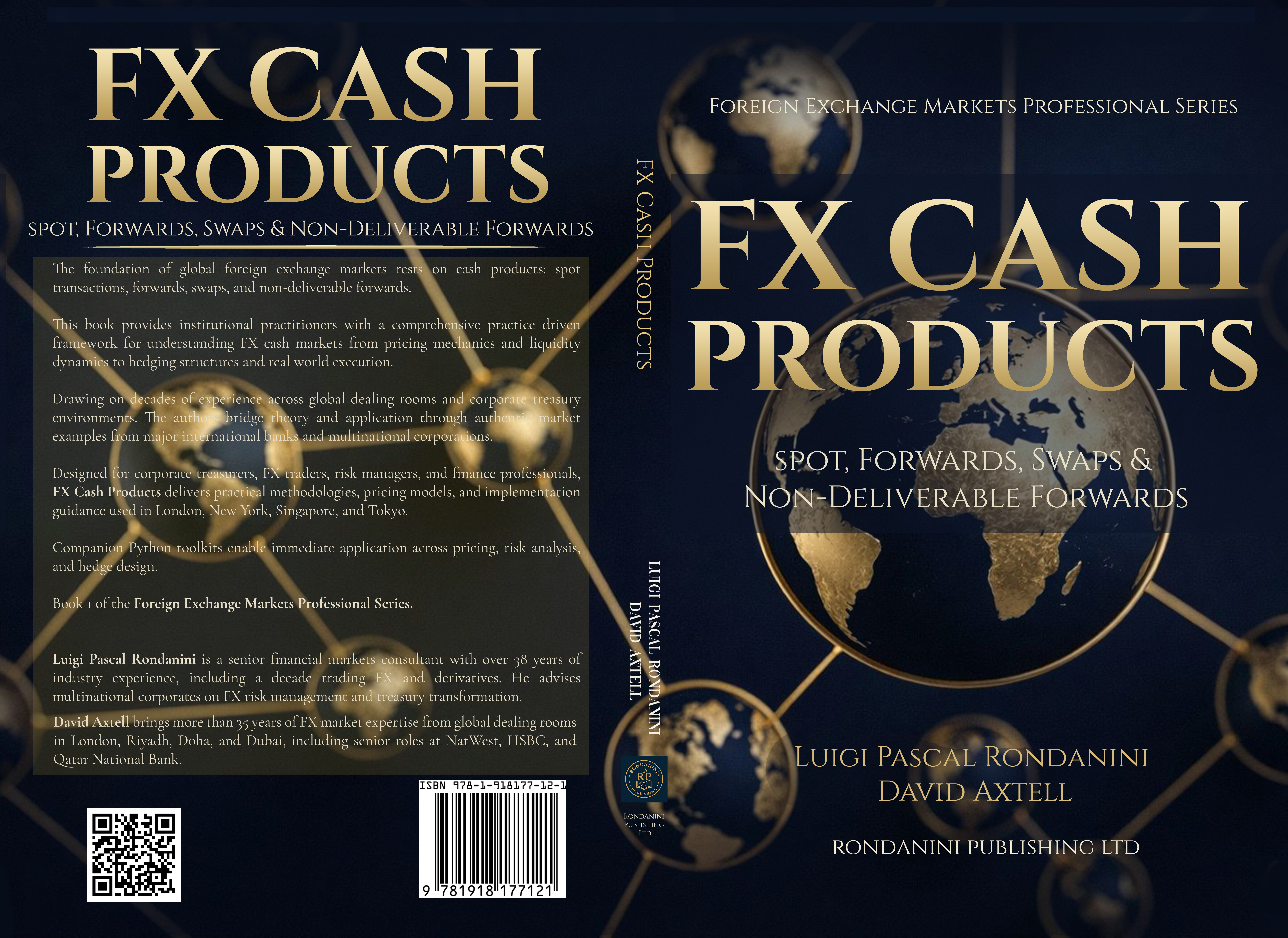
FX Cash Products: Spot, Forwards, Swaps & Non-Deliverable Forwards
Practitioner guide for treasury and markets
Luigi Pascal Rondanini · David Axtell · 2026 · Rondanini
Spot, forwards, swaps, and NDFs for corporate treasurers, traders, and risk managers—operations-first, institutionally framed.
- FX
- Treasury
- Risk management

Pricing and Trading Interest Rate Derivatives
A Practical Guide to Swaps
J. Hamish M. Darbyshire · 2022 · Aitch & Dee
A swaps trader’s bridge from curve building to book management: plain-vanilla and cross-currency IR swaps, risk, funding/CSA colour, and the distance between classroom models and how desks actually work. Third-edition material includes practical Python illustrations alongside the narrative.
- Derivatives
- Fixed income
- Interest rates

Options, Futures, and Other Derivatives
Global edition
John C. Hull · 2021 · Pearson
The standard graduate-level derivatives text.
- Derivatives
- Risk management
- Quantitative finance

Modern Computational Finance
Scripting for Derivatives and xVA
Antoine Savine · Jesper Andreasen · 2021 · John Wiley & Sons
Second volume: building professional derivative scripting systems—cash-flow representation, branching, American Monte Carlo hooks, and how scripting supports xVA-style portfolio interrogation. Written for quant devs and library architects who must ship maintainable payoff DSLs.
- Derivatives
- Risk management
- Quantitative finance