
Pearson · 2021
Options, Futures, and Other Derivatives
Global edition
Level · Institutional / advanced
Editorial summary
This title occupies a pivotal position on the shelf of derivatives literature, serving as both a foundational text for students and a reference for practitioners. Hull's approach combines theoretical frameworks with practical applications, making it suitable for traders, analysts, and risk managers alike. The book is structured to guide readers through the complexities of derivatives, offering a thorough exploration of options, futures, and other derivative instruments.
Readers will engage with a variety of methods, including the Black-Scholes-Merton model for pricing options, and gain insights into the valuation of commodity derivatives and the intricacies of swaps. The text also addresses critical contemporary issues, such as the impact of the credit crisis and recent regulatory changes, ensuring that the content is relevant to current market conditions.
The mathematical rigor of the book is appropriate for those with a solid grounding in quantitative finance, as it delves into the statistical and probabilistic models that underpin derivative pricing and risk assessment. This makes it a valuable resource for desk, treasury, or risk teams looking to enhance their understanding of market dynamics and risk management strategies.
Despite its comprehensive nature, the text may present challenges for readers without a strong quantitative background, as it assumes familiarity with advanced mathematical concepts. However, for those willing to engage deeply with the material, the book promises to enhance their competency in navigating the derivatives landscape.
Hull's work is not just an academic resource; it serves as a practical guide that bridges the gap between theory and real-world application, making it indispensable for professionals aiming to stay informed about the latest trends and regulations in the derivatives market.
About this book
Options, Futures, and Other Derivatives is structured to provide a thorough understanding of the derivatives market, presenting both foundational concepts and advanced topics. The text begins with an introduction to the basic instruments of derivatives, including options and futures, before progressing to more complex topics such as swaps and structured products. Each chapter builds on the last, ensuring a logical flow that facilitates comprehension.
Core technical ideas are presented with clarity, focusing on the pricing and valuation of derivatives through established models such as the Black-Scholes-Merton formula. The text also explores risk management techniques, highlighting the importance of derivatives in hedging strategies and portfolio management. Readers will find a wealth of examples and exercises that reinforce learning and encourage practical application of theoretical concepts.
Prerequisites for engaging with this text include a solid understanding of financial principles and a basic proficiency in quantitative methods. The book is designed for institutional readers, including students in finance and economics, as well as professionals in trading and risk management roles. By the end of the book, readers should expect to have a comprehensive grasp of how derivatives function within financial markets and how they can be utilised for risk management.
The competency gained from this text extends beyond theoretical knowledge; it equips readers with the tools necessary to navigate real-world financial scenarios involving derivatives. This includes understanding regulatory frameworks and the implications of recent market events, such as the credit crisis, on derivative instruments. Overall, Hull's work is a vital resource for anyone looking to deepen their expertise in derivatives and their applications in finance.
Why it matters
Understanding derivatives is crucial for managing risk, pricing assets, and ensuring compliance with regulatory standards in today's complex financial markets. This text provides the necessary framework for professionals to effectively utilise derivatives in their workflows, whether for hedging, speculation, or investment strategies.
Best for
This book is best suited for traders, analysts, and risk managers seeking a comprehensive understanding of derivatives markets and their applications. It is also ideal for students in finance and economics courses who require a robust resource on quantitative finance and risk management.
Not ideal for
It may not be ideal for readers without a strong quantitative background, as the mathematical concepts can be challenging for those unfamiliar with advanced finance topics. Additionally, casual readers seeking a general overview of finance may find the content too technical.
Key themes
derivatives|risk-management|quantitative-finance|options|futures|swaps|market-regulation|financial-engineering|pricing-models|hedging-strategies
Strengths
One of the key strengths of Hull's text is its comprehensive coverage of the derivatives market, making it a definitive guide for both academic and professional audiences. The integration of contemporary examples and discussions of current regulatory issues enhances its relevance and applicability. The structured approach allows readers to build their knowledge progressively, while the inclusion of exercises and real-world applications reinforces learning and practical understanding.
Limitations
A notable limitation is the book's assumption of a solid quantitative foundation, which may pose challenges for readers lacking in mathematical proficiency. Additionally, while the text is thorough, some readers may find the depth of detail overwhelming, particularly if they are seeking a more introductory overview of derivatives. The focus on institutional-level content may also limit its accessibility for casual readers or those new to the field.
Related books
Shared topics with this title.
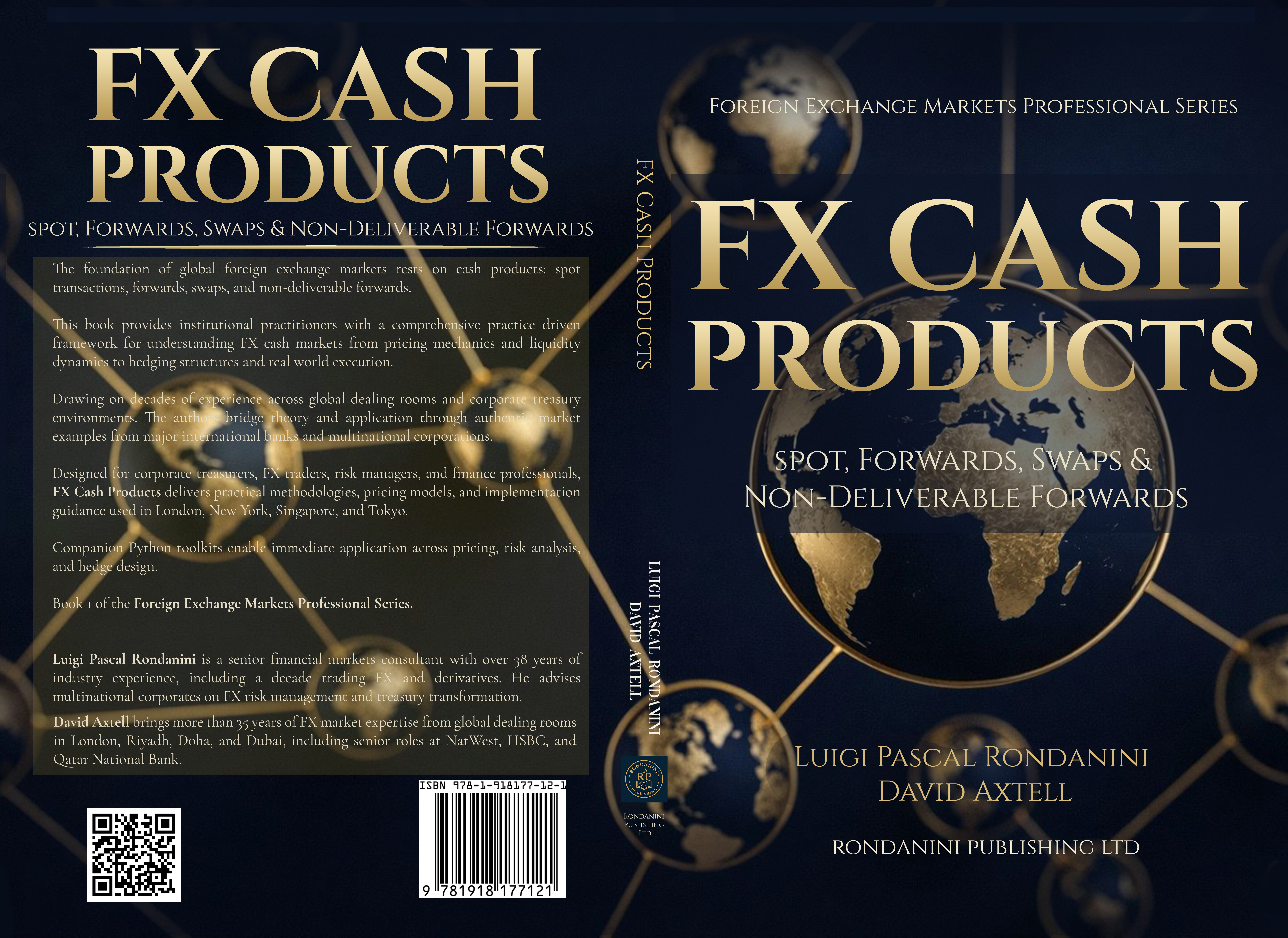
FX Cash Products: Spot, Forwards, Swaps & Non-Deliverable Forwards
Practitioner guide for treasury and markets
Luigi Pascal Rondanini · David Axtell · 2026 · Rondanini
Spot, forwards, swaps, and NDFs for corporate treasurers, traders, and risk managers—operations-first, institutionally framed.
- FX
- Treasury
- Risk management

Pricing and Trading Interest Rate Derivatives
A Practical Guide to Swaps
J. Hamish M. Darbyshire · 2022 · Aitch & Dee
A swaps trader’s bridge from curve building to book management: plain-vanilla and cross-currency IR swaps, risk, funding/CSA colour, and the distance between classroom models and how desks actually work. Third-edition material includes practical Python illustrations alongside the narrative.
- Derivatives
- Fixed income
- Interest rates

Modern Computational Finance
Scripting for Derivatives and xVA
Antoine Savine · Jesper Andreasen · 2021 · John Wiley & Sons
Second volume: building professional derivative scripting systems—cash-flow representation, branching, American Monte Carlo hooks, and how scripting supports xVA-style portfolio interrogation. Written for quant devs and library architects who must ship maintainable payoff DSLs.
- Derivatives
- Risk management
- Quantitative finance

High Performance Computing: Modern Systems and Applications
Michael Gorelick · Iman Ozsvald · 2019 · O Reilly
This comprehensive volume delves into high-performance computing (HPC) systems and their applications, particularly in quantitative finance and technology. It covers modern architectures, programming models, and performance optimization techniques essential for practitioners in the field.
- Quantitative finance
- Technology