
John Wiley & Sons · 2010
Financial Risk Manager Handbook
Level · Institutional / advanced
Editorial summary
The Financial Risk Manager Handbook is positioned as a key resource for professionals in risk management, offering a thorough exploration of market, credit, operational, and investment risk. This handbook is particularly valuable for those preparing for the Financial Risk Manager (FRM) certification, as it covers essential concepts and methodologies relevant to the examination and practical application in the field.
Readers will navigate through structured sections that address various risk types, providing a blend of theoretical frameworks and practical insights. The book delves into risk measurement techniques, the regulatory environment, and the integration of risk management strategies within financial institutions. Key themes include risk assessment methodologies, the impact of market dynamics, and the importance of operational risk management.
The text employs a moderate level of mathematical detail, making it accessible to both seasoned professionals and students. It features real-world case studies and examples that illustrate the application of risk management principles in practice, enhancing the reader's understanding of complex concepts. Risk teams will find this handbook useful for developing and implementing risk management frameworks tailored to their specific organisational needs.
While the handbook is comprehensive, it is essential to note that the 6th edition may not cover the most recent developments in risk management, given the rapidly evolving nature of the financial landscape. However, it remains a foundational text that equips readers with the necessary skills to navigate the complexities of financial risk.
Overall, the Financial Risk Manager Handbook is a vital resource for anyone involved in risk management, providing a solid foundation and practical tools for managing financial risks effectively.
About this book
The Financial Risk Manager Handbook is structured into several key sections that comprehensively cover the various dimensions of financial risk. It begins with an introduction to the fundamental concepts of risk management, setting the stage for deeper exploration into specific risk types such as market, credit, operational, and investment risks. Each section is designed to build upon the previous one, allowing readers to develop a cohesive understanding of how these risks interrelate and impact financial institutions.
Core technical ideas include risk measurement and management techniques, regulatory frameworks, and the integration of risk management into organisational strategies. The book also addresses the quantitative aspects of risk management, providing readers with the tools to perform risk assessments and analyses. This includes discussions on Value at Risk (VaR), stress testing, and scenario analysis, which are essential for effective risk management practices.
Prerequisites for readers include a foundational understanding of finance and basic statistical concepts, as the text employs quantitative methods to illustrate risk management principles. By engaging with the material, readers can expect to gain competencies in identifying, measuring, and managing various types of financial risks, as well as an understanding of the regulatory landscape that governs these practices.
The handbook is particularly useful for risk managers and students preparing for the FRM certification, as it aligns closely with the topics covered in the exam. It serves as both a study guide and a reference for practitioners, equipping them with the knowledge needed to implement effective risk management strategies in real-world scenarios.
Why it matters
The Financial Risk Manager Handbook is crucial for professionals engaged in risk management as it provides the foundational knowledge necessary for effective risk assessment and mitigation. With a focus on practical applications, it supports live workflows related to compliance, risk limits, and strategic decision-making in financial institutions.
Best for
This handbook is best suited for risk managers, financial analysts, and students pursuing a career in risk management or preparing for the FRM certification. It serves as an essential resource for those looking to deepen their understanding of financial risk principles and practices.
Not ideal for
It may not be ideal for readers seeking the latest advancements in risk management or those without a basic understanding of finance and statistics, as the text assumes some prior knowledge in these areas.
Key themes
risk-management|market-risk|credit-risk|operational-risk|investment-risk|regulatory-compliance|risk-assessment|financial-institutions|quantitative-methods|frm-certification
Strengths
The strengths of the Financial Risk Manager Handbook lie in its comprehensive coverage of various risk types and its structured approach to presenting complex concepts. The integration of real-world examples and case studies enhances the learning experience, making it applicable to both academic and professional settings. Additionally, the handbook's alignment with the FRM certification makes it a valuable resource for those preparing for the examination, ensuring that readers are well-equipped with the necessary knowledge and skills.
Limitations
One limitation of the handbook is that while it provides a thorough overview of risk management principles, it may not include the most recent developments in the field, given the publication date of 2010. As the financial landscape continues to evolve, readers may need to supplement their learning with more current resources to stay abreast of the latest trends and regulatory changes in risk management.
Related books
Shared topics with this title.
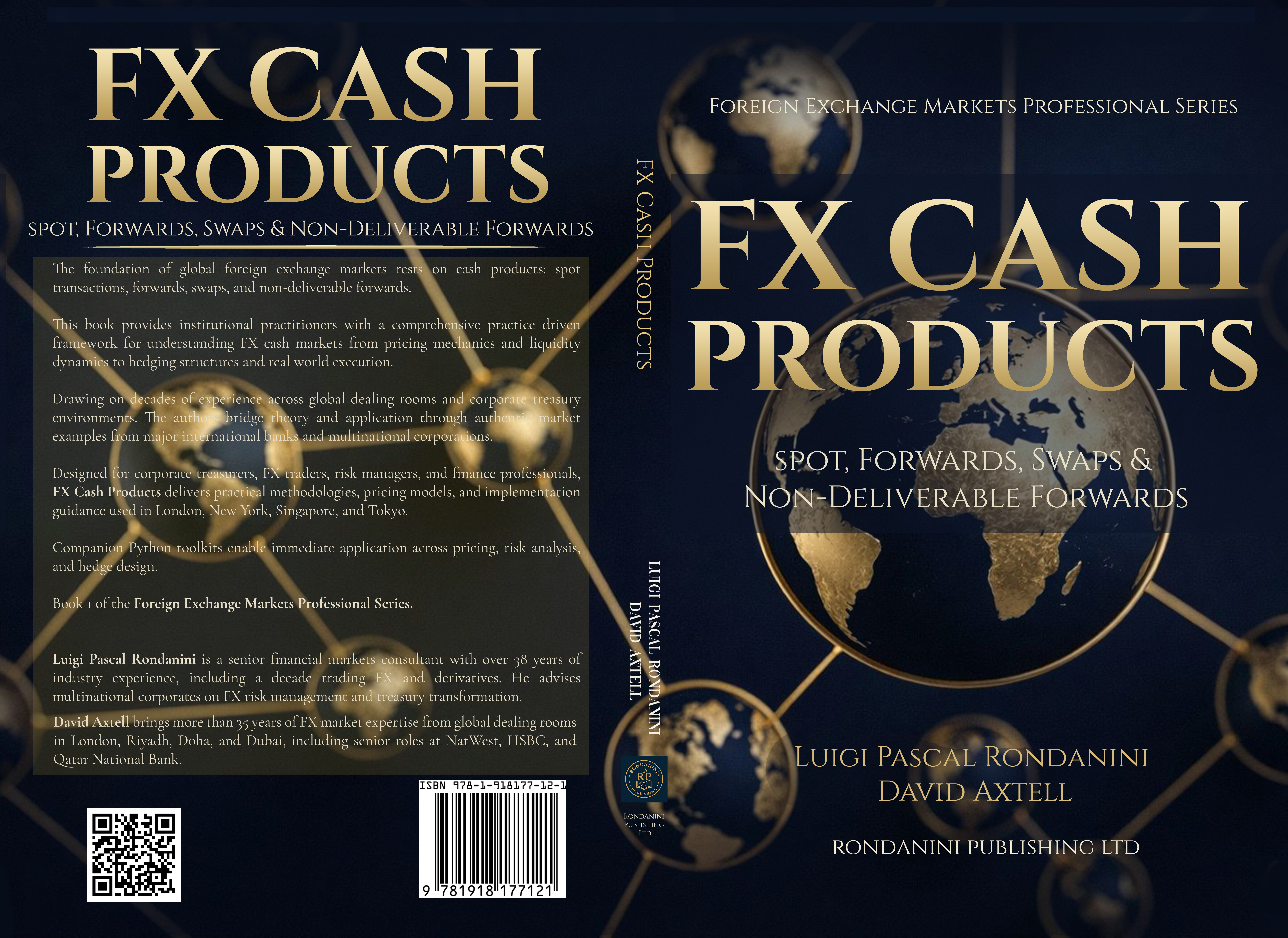
FX Cash Products: Spot, Forwards, Swaps & Non-Deliverable Forwards
Practitioner guide for treasury and markets
Luigi Pascal Rondanini · David Axtell · 2026 · Rondanini
Spot, forwards, swaps, and NDFs for corporate treasurers, traders, and risk managers—operations-first, institutionally framed.
- FX
- Treasury
- Risk management

Options, Futures, and Other Derivatives
Global edition
John C. Hull · 2021 · Pearson
The standard graduate-level derivatives text.
- Derivatives
- Risk management
- Quantitative finance

Modern Computational Finance
Scripting for Derivatives and xVA
Antoine Savine · Jesper Andreasen · 2021 · John Wiley & Sons
Second volume: building professional derivative scripting systems—cash-flow representation, branching, American Monte Carlo hooks, and how scripting supports xVA-style portfolio interrogation. Written for quant devs and library architects who must ship maintainable payoff DSLs.
- Derivatives
- Risk management
- Quantitative finance

Modern Computational Finance
AAD and Parallel Simulations
Antoine Savine · Leif B. G. Andersen · 2018 · John Wiley & Sons
Institutional quant text on algorithmic adjoint differentiation (AAD), parallel Monte Carlo, and implementation-minded pricing/risk—written by practitioners who shipped large bank systems. Pairs naturally with scripting and xVA volumes for a full modern computational stack.
- Derivatives
- Risk management
- Quantitative finance