
John Wiley & Sons · 2008
Commodity Risk Management
Level · Intermediate
Editorial summary
Commodity Risk Management positions itself as a crucial resource for professionals engaged in the commodities sector, offering insights that are particularly relevant for treasury and risk management functions. The book delves into the intricacies of commodity pricing mechanisms, risk assessment techniques, and the regulatory environment affecting commodity markets. Readers will find practical frameworks and methodologies that can be applied directly to their daily operations, enhancing their understanding of market dynamics.
The text is structured to guide readers through various risk management strategies, including the identification, measurement, and mitigation of risks associated with commodity trading. It covers a range of topics from market volatility to the impact of geopolitical factors on commodity prices, providing a comprehensive overview that is both theoretical and practical. The author employs a balanced approach, combining quantitative methods with qualitative insights to equip readers with a well-rounded perspective.
Mathematical concepts are presented at an intermediate level, making the material accessible to those with a foundational understanding of finance and risk management. The book does not shy away from complex topics, ensuring that readers are well-prepared to tackle real-world challenges in the commodities market. This makes it particularly useful for treasury teams and risk managers who need to develop robust risk frameworks.
While the book is rich in content, it is important to note that the evidence base is somewhat limited, as it primarily reflects the author's perspectives and experiences rather than a comprehensive survey of the field. However, it still serves as a valuable reference for practitioners looking to deepen their knowledge of commodity risk management.
Overall, Commodity Risk Management is an essential addition to the library of any finance professional involved in commodities, providing both strategic insights and practical tools necessary for effective risk management in this volatile market.
About this book
Commodity Risk Management is structured to provide a comprehensive overview of the key concepts and practices associated with risk management in the commodities sector. The book begins with foundational principles, introducing readers to the unique characteristics of commodity markets and the various types of risks that can arise. It then progresses to more advanced topics, including the analysis of market trends, the use of derivatives for hedging, and the implications of regulatory frameworks on trading practices.
Core technical ideas explored in the text include the methodologies for assessing price volatility, the impact of external factors such as weather and geopolitical events on commodity prices, and the development of risk management strategies tailored to specific commodities. Readers can expect to gain a solid understanding of how to implement risk assessment tools and techniques, as well as how to interpret market signals that may affect their trading decisions.
Prerequisites for readers include a basic understanding of financial principles and an interest in commodities trading. The book is designed for an intermediate audience, making it suitable for treasurers, risk managers, and CFOs who are already familiar with the fundamentals of finance but seek to enhance their expertise in commodity risk management.
Competency gained from this text includes the ability to identify and evaluate risks in commodity trading, develop effective risk management strategies, and apply quantitative methods to real-world scenarios. By the end of the book, readers should feel confident in their ability to navigate the complexities of the commodities market and implement sound risk management practices.
Why it matters
Understanding commodity risk management is crucial for finance professionals as it directly impacts pricing strategies, risk limits, and compliance with regulatory requirements. Effective risk management in commodities can lead to better decision-making, enhanced profitability, and improved financial stability within organisations involved in trading or investing in commodities.
Best for
This book is best suited for treasurers, risk managers, and CFOs who are looking to deepen their knowledge of commodity risk management. It is also valuable for finance executives involved in strategic decision-making related to commodity trading and investment.
Not ideal for
It may not be ideal for beginners in finance or those without a foundational understanding of commodities, as the material is geared towards an intermediate audience and assumes some prior knowledge of financial concepts.
Key themes
commodity-risk-management|treasury|risk-assessment|commodities|financial-strategies|market-volatility|regulatory-frameworks|hedging|quantitative-methods|trading-practices
Strengths
One of the key strengths of Commodity Risk Management is its practical approach to complex topics, providing readers with actionable insights and methodologies that can be applied in real-world scenarios. The book's structured format allows for a gradual build-up of knowledge, making it accessible for professionals looking to enhance their expertise. Additionally, the author’s experience in the field lends credibility to the insights presented, ensuring that the content is relevant and applicable to current market conditions.
Limitations
Despite its strengths, the book has limitations in terms of the depth of empirical evidence provided. Much of the content is based on the author's perspectives, which may not encompass the full spectrum of views in the field of commodity risk management. Readers seeking a more comprehensive analysis supported by extensive case studies or empirical research may find this text lacking in that regard.
Related books
Shared topics with this title.
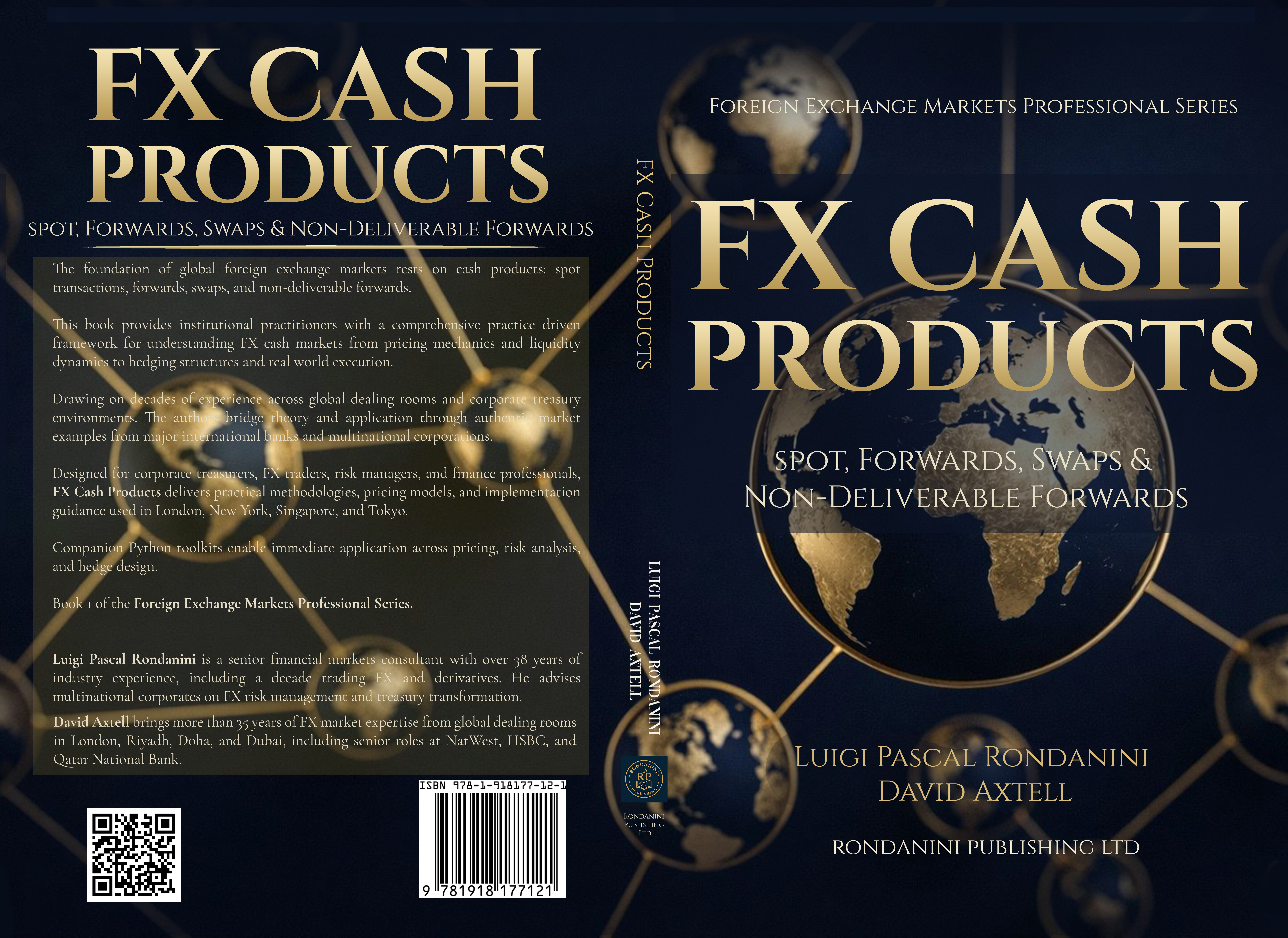
FX Cash Products: Spot, Forwards, Swaps & Non-Deliverable Forwards
Practitioner guide for treasury and markets
Luigi Pascal Rondanini · David Axtell · 2026 · Rondanini
Spot, forwards, swaps, and NDFs for corporate treasurers, traders, and risk managers—operations-first, institutionally framed.
- FX
- Treasury
- Risk management

Modern Computational Finance
Scripting for Derivatives and xVA
Antoine Savine · Jesper Andreasen · 2021 · John Wiley & Sons
Second volume: building professional derivative scripting systems—cash-flow representation, branching, American Monte Carlo hooks, and how scripting supports xVA-style portfolio interrogation. Written for quant devs and library architects who must ship maintainable payoff DSLs.
- Derivatives
- Quantitative finance
- Risk management

Options, Futures, and Other Derivatives
Global edition
John C. Hull · 2021 · Pearson
The standard graduate-level derivatives text.
- Derivatives
- Risk management
- Quantitative finance

Cybersecurity in Financial Services: Frameworks and Best Practices
Kevin Mandia · 2018 · John Wiley & Sons
This comprehensive guide addresses the critical intersection of cybersecurity and financial services, offering frameworks and best practices essential for risk managers and technology professionals. It outlines strategies to mitigate risks associated with cyber threats in the financial sector.
- Risk management
- Technology
- Regulation & compliance