
John Wiley & Sons · 2011
Understanding and Managing Model Risk
Level · Institutional / advanced
Editorial summary
Understanding and Managing Model Risk by Massimo Morini provides a comprehensive examination of model risk, essential for professionals in risk management and quantitative analysis. The text delves into the governance of pricing models, offering insights into the frameworks necessary for effective model validation and oversight. Readers will engage with quantitative methods that underpin model risk assessment, making it a valuable resource for both theoretical understanding and practical application.
The book is structured to guide readers through the complexities of model risk, addressing key themes such as model validation processes, the importance of governance frameworks, and the implications of model risk on trading strategies. It is particularly relevant for risk managers and quants who are tasked with ensuring that models are robust and compliant with regulatory standards.
Mathematical rigor is present throughout the text, catering to an institutional reading level, which suggests that readers should have a foundational understanding of quantitative methods and risk management principles. This makes it suitable for professionals who are already familiar with the complexities of financial models and their associated risks.
Risk, treasury, and trading teams can utilise this book to enhance their understanding of model risk, improve governance practices, and refine their validation processes. The practical insights provided can help in developing more resilient trading strategies and in meeting compliance requirements.
While the book offers a thorough exploration of model risk, the scope of its content may not cover every emerging trend in the rapidly evolving field of quantitative finance. Readers seeking the latest developments in model risk may need to supplement their reading with additional resources.
About this book
Understanding and Managing Model Risk is a foundational text that explores the intricacies of model risk within the financial sector. Authored by Massimo Morini, this book is designed for professionals engaged in risk management, quantitative analysis, and trading. It provides a structured approach to understanding the governance of pricing models, which is crucial for ensuring that financial institutions can effectively manage the risks associated with their models.
The book covers essential topics such as model validation processes, the establishment of governance frameworks, and the assessment of model risk. Readers will find detailed discussions on the methodologies used to evaluate the robustness of financial models, as well as the implications of model risk on trading and risk management strategies. The content is oriented toward practitioners who require a solid grasp of quantitative methods and their application in real-world scenarios.
To fully benefit from this text, readers should possess a background in quantitative finance and risk management principles. The book assumes familiarity with mathematical concepts and statistical techniques, making it suitable for institutional-level readers. By engaging with the material, professionals can expect to enhance their competency in model risk assessment and governance.
Overall, Understanding and Managing Model Risk serves as a crucial resource for those looking to deepen their understanding of model risk and improve their practices in model validation and governance. It equips readers with the knowledge necessary to navigate the complexities of model risk in today's financial landscape.
Why it matters
Understanding and Managing Model Risk is vital for professionals involved in risk management and quantitative analysis, as it addresses the critical need for robust model governance and validation. The insights gained from this book can directly impact workflows related to pricing, risk limits, and compliance, ensuring that financial models are both effective and reliable in managing market risks.
Best for
This book is best suited for risk managers, quantitative analysts, and traders who seek to enhance their understanding of model risk and its implications for financial practices. It is particularly valuable for those involved in model validation and governance processes.
Not ideal for
It may not be ideal for beginners in finance or those without a foundational understanding of quantitative methods, as the content assumes a certain level of expertise in risk management and financial modelling.
Key themes
model-risk|quantitative-methods|risk-management|pricing-models|model-validation|governance-frameworks|trading-strategies|financial-institutions|compliance
Strengths
One of the key strengths of Understanding and Managing Model Risk is its comprehensive approach to the topic, providing both theoretical insights and practical applications. The book effectively bridges the gap between quantitative methods and real-world risk management practices, making it a valuable resource for professionals in the field. Additionally, the focus on governance and validation processes is particularly relevant in the context of increasing regulatory scrutiny in the financial sector.
Limitations
Despite its strengths, the book may have limitations in terms of covering the latest trends and developments in model risk management. As the field of quantitative finance evolves rapidly, readers may need to seek supplementary resources to stay updated on emerging practices and technologies. Furthermore, the institutional reading level may pose challenges for those who are new to the subject matter, potentially limiting its accessibility to a broader audience.
Related books
Shared topics with this title.
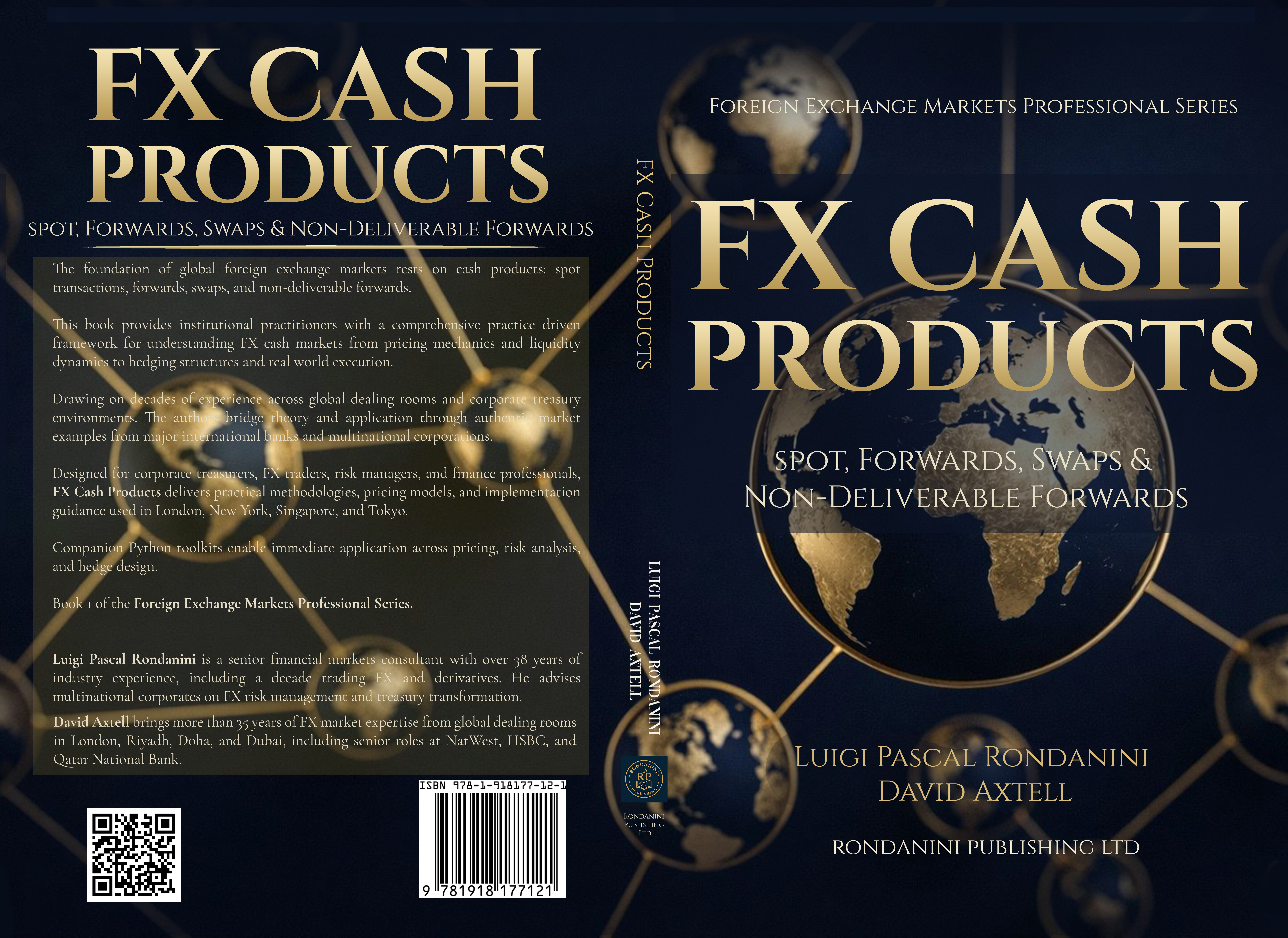
FX Cash Products: Spot, Forwards, Swaps & Non-Deliverable Forwards
Practitioner guide for treasury and markets
Luigi Pascal Rondanini · David Axtell · 2026 · Rondanini
Spot, forwards, swaps, and NDFs for corporate treasurers, traders, and risk managers—operations-first, institutionally framed.
- FX
- Treasury
- Risk management

Modern Computational Finance
Scripting for Derivatives and xVA
Antoine Savine · Jesper Andreasen · 2021 · John Wiley & Sons
Second volume: building professional derivative scripting systems—cash-flow representation, branching, American Monte Carlo hooks, and how scripting supports xVA-style portfolio interrogation. Written for quant devs and library architects who must ship maintainable payoff DSLs.
- Derivatives
- Quantitative finance
- Risk management

Options, Futures, and Other Derivatives
Global edition
John C. Hull · 2021 · Pearson
The standard graduate-level derivatives text.
- Derivatives
- Risk management
- Quantitative finance

Cybersecurity in Financial Services: Frameworks and Best Practices
Kevin Mandia · 2018 · John Wiley & Sons
This comprehensive guide addresses the critical intersection of cybersecurity and financial services, offering frameworks and best practices essential for risk managers and technology professionals. It outlines strategies to mitigate risks associated with cyber threats in the financial sector.
- Risk management
- Technology
- Regulation & compliance