
John Wiley & Sons · 2001
Structured Products and Hybrid Securities
2nd Edition
Level · Institutional / advanced
Editorial summary
In the realm of structured finance, Satyajit Das's Structured Products and Hybrid Securities stands out as a critical resource for traders, analysts, and portfolio managers. This text delves into the intricacies of structured products, offering insights that are particularly relevant for those engaged in derivatives and fixed income markets. The book is meticulously organised, guiding readers through the complexities of hybrid securities and their applications in risk management.
The reader can expect to navigate through various sections that detail the construction and valuation of structured products, alongside discussions on the associated risks. Key themes include the evaluation of market risk, credit risk, and liquidity risk, providing a comprehensive understanding of how these factors influence the performance of hybrid securities. The mathematical rigor employed in the text is suitable for institutional readers, ensuring that the content is both accessible and challenging.
Risk management is a recurring theme throughout the book, with practical methodologies highlighted for assessing and mitigating risks associated with structured products. This focus on risk is particularly beneficial for desk and treasury teams, who can apply the concepts to enhance their trading strategies and compliance frameworks. The book also addresses the regulatory landscape impacting structured products, making it a valuable reference for professionals navigating these complex instruments.
While the text is robust in its coverage, readers should be aware that the depth of mathematical detail may vary, and some sections may require a foundational understanding of financial derivatives. Nonetheless, the book serves as a vital tool for those looking to deepen their expertise in structured finance and risk management.
Overall, Das's work is positioned as a key reference alongside other titles in the derivatives and risk management space, offering a unique blend of theoretical and practical insights that are essential for market professionals.
About this book
Structured Products and Hybrid Securities is structured to provide a comprehensive exploration of complex financial instruments, primarily focusing on their design, valuation, and associated risks. The book is divided into several key sections, each addressing different aspects of structured products and hybrid securities, which are increasingly relevant in today's financial markets. Readers will find discussions on the mechanics of these instruments, including their cash flow structures and pricing methodologies.
The text delves into the various types of derivatives and fixed income products, examining their roles within investment portfolios and risk management frameworks. It covers essential topics such as market risk, credit risk, and liquidity risk, providing readers with a solid grounding in the principles of risk assessment and management. This foundational knowledge is crucial for professionals who need to navigate the complexities of structured finance effectively.
Mathematical concepts are integrated throughout the book, ensuring that readers are equipped with the quantitative skills necessary to analyse structured products. The level of mathematical detail is appropriate for institutional readers, making it suitable for those with a background in finance or related fields. The text also addresses the regulatory environment surrounding structured products, discussing the implications of compliance and risk management practices that are vital for financial institutions.
Competency gained from this book includes a thorough understanding of how structured products function within the broader financial landscape, as well as the ability to apply risk management techniques to assess and mitigate potential downsides. This makes the book an invaluable resource for traders, analysts, and portfolio managers who are involved in the design, trading, or oversight of these instruments.
Why it matters
Structured Products and Hybrid Securities is essential for professionals involved in trading, risk management, and compliance within financial markets. The insights provided on risk assessment and product valuation are directly applicable to live workflows, such as setting risk limits, pricing strategies, and ensuring regulatory compliance. Understanding these complex instruments is critical for effective portfolio management and risk mitigation.
Best for
This book is best suited for traders, analysts, and portfolio managers who require a deep understanding of structured products and their associated risks. It is particularly beneficial for those working in fixed income and derivatives markets, as well as risk management roles within financial institutions.
Not ideal for
It may not be ideal for beginners in finance or those seeking a broad overview of financial markets, as the content assumes a certain level of familiarity with derivatives and risk management concepts.
Key themes
structured-products|hybrid-securities|risk-management|fixed-income|derivatives|market-risk|credit-risk|liquidity-risk|valuation-methodologies|regulatory-compliance
Strengths
One of the key strengths of Structured Products and Hybrid Securities is its comprehensive coverage of complex financial instruments, making it an authoritative resource for market professionals. The book's structured approach allows readers to build their understanding progressively, with clear explanations of intricate concepts. Additionally, the integration of risk management methodologies throughout the text provides practical insights that can be directly applied in trading and portfolio management contexts. The mathematical rigor ensures that the content is suitable for institutional readers, enhancing its value as a reference work.
Limitations
Despite its strengths, the book may present challenges for readers who lack a solid foundation in financial derivatives and risk management. Some sections may delve into advanced mathematical concepts that could be daunting for those without the requisite background. Furthermore, while the text is thorough, the depth of coverage on certain topics may vary, potentially leaving some areas less explored than others. Readers seeking a more introductory perspective on structured products may find this book too advanced for their needs.
Related books
Shared topics with this title.
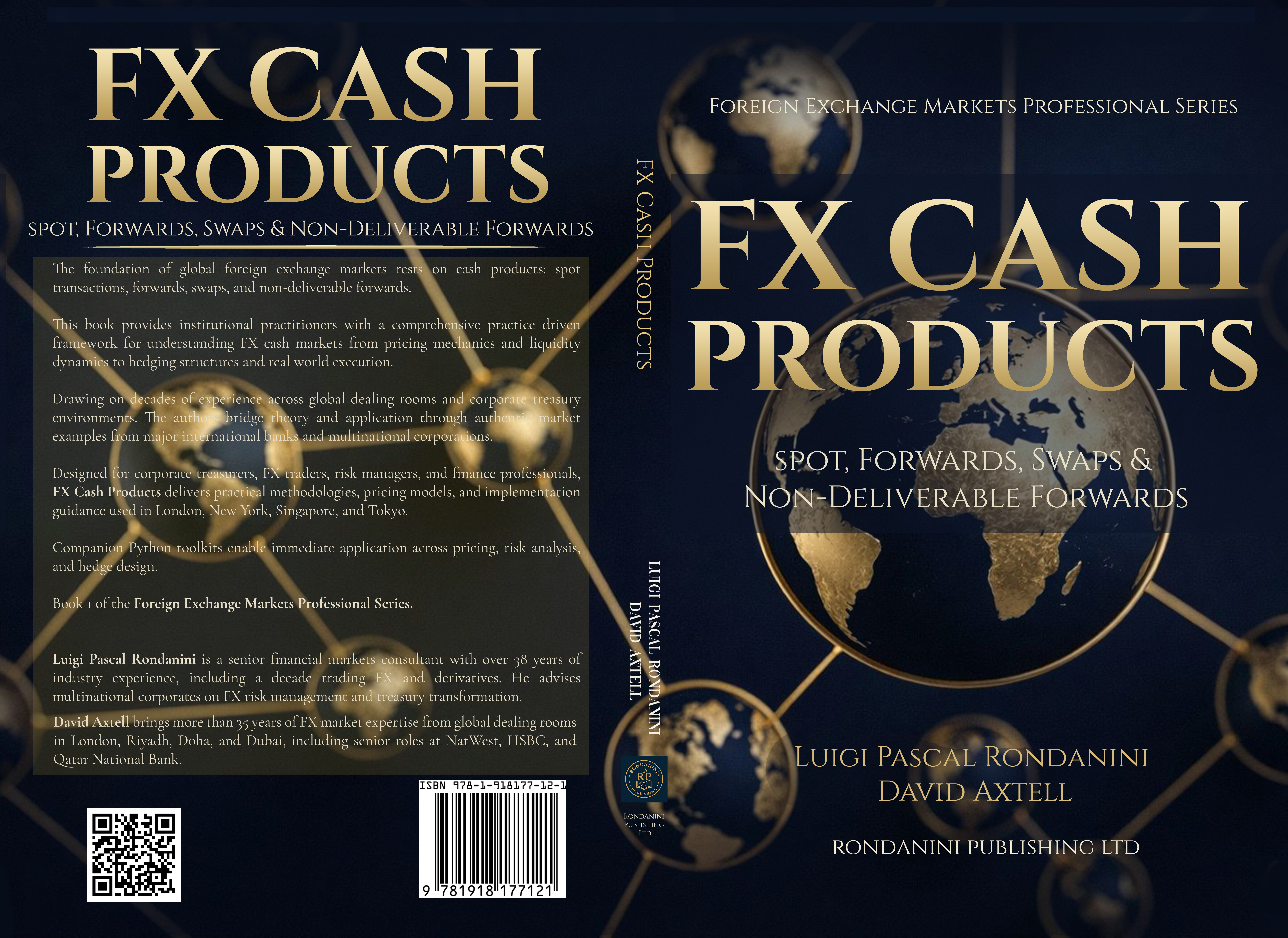
FX Cash Products: Spot, Forwards, Swaps & Non-Deliverable Forwards
Practitioner guide for treasury and markets
Luigi Pascal Rondanini · David Axtell · 2026 · Rondanini
Spot, forwards, swaps, and NDFs for corporate treasurers, traders, and risk managers—operations-first, institutionally framed.
- FX
- Treasury
- Risk management

Fixed Income Securities
Bruce Tuckman · Angel Serrat · 2022 · John Wiley & Sons
Modern fixed income analytics and curve thinking.
- Fixed income
- Interest rates

Pricing and Trading Interest Rate Derivatives
A Practical Guide to Swaps
J. Hamish M. Darbyshire · 2022 · Aitch & Dee
A swaps trader’s bridge from curve building to book management: plain-vanilla and cross-currency IR swaps, risk, funding/CSA colour, and the distance between classroom models and how desks actually work. Third-edition material includes practical Python illustrations alongside the narrative.
- Derivatives
- Fixed income
- Interest rates

Options, Futures, and Other Derivatives
Global edition
John C. Hull · 2021 · Pearson
The standard graduate-level derivatives text.
- Derivatives
- Risk management
- Quantitative finance