
John Wiley & Sons · 2015
Risk Management and Financial Institutions
Level · Institutional / advanced
Editorial summary
John C. Hull's Risk Management and Financial Institutions stands as a cornerstone text for those engaged in financial risk management, particularly within institutional settings. This edition delves into the intricacies of risk across multiple dimensions, including market risk, credit risk, operational risk, and liquidity risk. It is positioned alongside other key texts in the field, yet Hull's authoritative voice and practical approach set it apart as a definitive guide for both analysts and risk managers.
The book is structured to provide a thorough understanding of how financial institutions operate within regulatory frameworks. Each chapter addresses specific types of risks and their implications for financial institutions, with real-world examples and end-of-chapter practice problems that reinforce learning. The inclusion of a supplementary website enhances the learning experience, offering additional resources and tools for practitioners.
Mathematical concepts are interwoven throughout the text, catering to readers with a solid grounding in quantitative methods. Hull's treatment of complex topics, such as stress testing and model risk, ensures that readers not only grasp theoretical concepts but also apply them in practical scenarios. This makes the book particularly useful for desk, treasury, and risk teams looking to navigate the evolving landscape of financial regulation and risk assessment.
While the text is comprehensive, readers should be aware that its depth may require a foundational understanding of finance and risk management principles. The focus on institutional risk management means that those seeking a broader overview of financial markets may find the content more specialised than expected. Nonetheless, Hull's expertise and the book's practical orientation make it an invaluable resource for those committed to mastering risk management in financial institutions.
Overall, Risk Management and Financial Institutions is an essential text for professionals aiming to deepen their understanding of financial risk and regulatory issues. Its thorough coverage, practical applications, and supplementary materials make it a go-to resource for both current practitioners and students in the field.
About this book
Risk Management and Financial Institutions is a detailed examination of the various risks faced by financial institutions, authored by esteemed expert John C. Hull. The book is structured to cover a range of risk types, including market risk, credit risk, operational risk, liquidity risk, and model risk, providing a holistic view of the risk landscape within financial markets. Each section is designed to build upon the previous one, ensuring that readers develop a comprehensive understanding of how these risks interact and the regulatory frameworks that govern them.
The text begins with an introduction to the fundamental concepts of risk management, laying the groundwork for more complex discussions. Hull elaborates on the roles and activities of different financial institutions, illustrating how they are regulated and the implications of these regulations on risk management practices. The book also addresses contemporary issues such as liquidity risk and stress testing, reflecting the evolving nature of the financial sector and the increasing importance of robust risk management strategies.
Readers can expect to engage with a variety of mathematical models and quantitative methods throughout the book, which are essential for analysing and managing financial risks effectively. Hull's approach combines theoretical insights with practical applications, making it suitable for both analysts and risk managers who need to apply these concepts in their daily work. The inclusion of end-of-chapter problems allows readers to test their understanding and apply what they have learned in a practical context.
The supplementary website associated with the book provides additional resources, including software and unique learning aids, further enhancing the educational experience. This feature is particularly beneficial for those seeking to apply theoretical concepts in real-world scenarios, making the book not only a learning tool but also a practical guide for professionals in the field of risk management.
Why it matters
Understanding risk management is crucial for financial professionals as it directly impacts decision-making processes related to pricing, compliance, and funding. Hull's text equips readers with the knowledge to assess and mitigate risks effectively, which is essential for maintaining risk limits and ensuring regulatory compliance in a complex financial environment.
Best for
This book is best suited for analysts and risk managers seeking to deepen their understanding of financial risk management. It serves as a valuable resource for students pursuing careers in finance or risk management, as well as professionals looking to stay updated on regulatory changes and risk assessment techniques.
Not ideal for
It may not be ideal for beginners in finance who lack foundational knowledge, as the text assumes a certain level of familiarity with financial concepts and quantitative methods. Additionally, those seeking a broad overview of financial markets may find the focus on institutional risk management too specialised.
Key themes
risk-management|financial-institutions|market-risk|credit-risk|operational-risk|liquidity-risk|regulatory-frameworks|quantitative-methods|stress-testing|model-risk
Strengths
One of the primary strengths of Risk Management and Financial Institutions is its comprehensive coverage of various types of financial risks and the regulatory landscape governing financial institutions. Hull's clear explanations and structured approach make complex topics accessible, while the inclusion of practical examples and end-of-chapter problems enhances the learning experience. The supplementary website further enriches the text, providing additional tools and resources for practitioners. Hull's reputation as a leading authority in the field adds credibility to the content, ensuring that readers are learning from a respected expert.
Moreover, the book's focus on contemporary issues, such as liquidity risk and stress testing, ensures that it remains relevant in an ever-evolving financial landscape. This makes it an indispensable resource for professionals who need to stay informed about the latest developments in risk management and regulatory practices.
Limitations
Despite its many strengths, the book may present challenges for readers who are new to the field of finance or risk management. The mathematical and technical nature of some sections may be daunting for those without a solid grounding in quantitative methods. Additionally, while the text provides in-depth coverage of institutional risk management, it may not cater to those seeking a broader perspective on financial markets. This specialised focus could limit its appeal to a wider audience, making it essential for potential readers to assess their own knowledge and needs before engaging with the material.
Related books
Shared topics with this title.
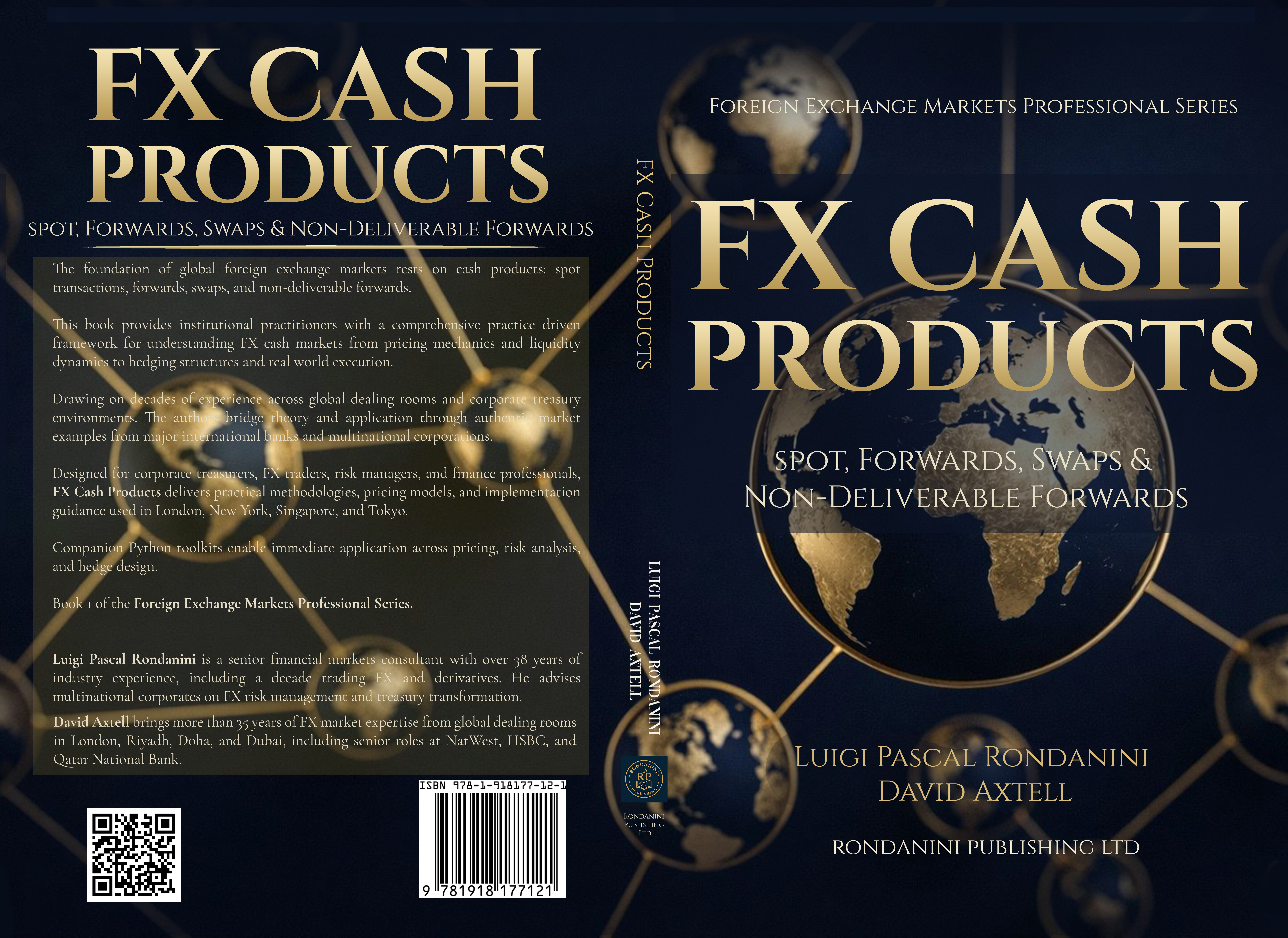
FX Cash Products: Spot, Forwards, Swaps & Non-Deliverable Forwards
Practitioner guide for treasury and markets
Luigi Pascal Rondanini · David Axtell · 2026 · Rondanini
Spot, forwards, swaps, and NDFs for corporate treasurers, traders, and risk managers—operations-first, institutionally framed.
- FX
- Treasury
- Risk management

Pricing and Trading Interest Rate Derivatives
A Practical Guide to Swaps
J. Hamish M. Darbyshire · 2022 · Aitch & Dee
A swaps trader’s bridge from curve building to book management: plain-vanilla and cross-currency IR swaps, risk, funding/CSA colour, and the distance between classroom models and how desks actually work. Third-edition material includes practical Python illustrations alongside the narrative.
- Fixed income
- Interest rates
- Derivatives

Modern Computational Finance
Scripting for Derivatives and xVA
Antoine Savine · Jesper Andreasen · 2021 · John Wiley & Sons
Second volume: building professional derivative scripting systems—cash-flow representation, branching, American Monte Carlo hooks, and how scripting supports xVA-style portfolio interrogation. Written for quant devs and library architects who must ship maintainable payoff DSLs.
- Derivatives
- Quantitative finance
- Risk management

Options, Futures, and Other Derivatives
Global edition
John C. Hull · 2021 · Pearson
The standard graduate-level derivatives text.
- Derivatives
- Risk management
- Quantitative finance