
John Wiley & Sons · 2010
Option Trading: Pricing and Volatility Strategies and Techniques
Level · Practitioner
Editorial summary
Euan Sinclair's 'Option Trading' stands as a pivotal resource on the shelf for practitioners focused on derivatives and risk management. Unlike introductory texts, this book delves into the complexities of options trading, providing a thorough exploration of pricing mechanisms, volatility strategies, and risk assessment techniques. It is particularly suited for those who have a foundational understanding of finance and seek to deepen their expertise in options.
The book is structured to guide readers through the essential components of options trading, starting from historical context and market structure to advanced topics such as implied volatility and the Greeks. Sinclair meticulously breaks down the intricacies of option pricing, offering practical insights into forecasting and hedging. Each chapter builds upon the last, ensuring that readers not only grasp theoretical concepts but also apply them in real-world scenarios.
Mathematically inclined readers will find the content accessible yet challenging, as Sinclair incorporates quantitative methods relevant to pricing and volatility analysis. The book is particularly beneficial for desk, treasury, or risk teams, as it provides actionable strategies and frameworks for managing options portfolios effectively.
While the book is comprehensive, it is essential to note that it assumes a certain level of prior knowledge in finance and derivatives. Readers new to options trading may need supplementary resources to fully appreciate the advanced strategies discussed. Nevertheless, for those already engaged in the field, this text serves as a vital tool for refining their trading practices.
In summary, 'Option Trading' is not just a theoretical exposition; it is a practical guide that equips traders and analysts with the necessary tools to navigate the complexities of the options market, making it a valuable addition to any financial library.
About this book
Euan Sinclair's 'Option Trading: Pricing and Volatility Strategies and Techniques' is a comprehensive text designed for practitioners engaged in the options market. The book is structured to provide a thorough understanding of the various dimensions of options trading, beginning with an overview of historical context, contract types, and market structure. Sinclair's approach is methodical, ensuring that readers can build a solid foundation before delving into more complex topics.
Central to the book are the concepts of option pricing and volatility measurement. Sinclair explains the mathematical models that underpin these concepts, including the Greeks, which are crucial for understanding how options prices react to changes in market conditions. The text also covers volatility forecasting and hedging techniques, providing readers with the tools necessary to manage risk effectively in their trading strategies.
Throughout the book, Sinclair emphasises practical applications, offering strategies that can be employed in real-world trading scenarios. He discusses how to break down typical positions and repair them when necessary, making the content particularly relevant for professional traders who need to adapt to changing market dynamics. The book also addresses the various concerns that options traders face, ensuring that it remains applicable across different market environments.
Readers can expect to gain a robust competency in options trading, including the ability to assess risk, implement pricing strategies, and utilise volatility measures in their decision-making processes. The book is well-suited for those who are already familiar with financial concepts and are looking to enhance their trading acumen in the derivatives space. Sinclair's insights are grounded in his experience as a professional trader and quantitative analyst, lending credibility and depth to the material presented.
Overall, 'Option Trading' serves as an essential guide for traders and analysts alike, offering a blend of theoretical knowledge and practical strategies that are vital for success in the options market. It stands as a key resource for those looking to refine their skills and navigate the complexities of options trading effectively.
Why it matters
Understanding options trading is crucial for professionals engaged in risk management, pricing strategies, and compliance within financial markets. This book equips readers with the necessary frameworks and techniques to optimise their trading strategies, manage risk effectively, and respond adeptly to market fluctuations. As options continue to play a significant role in financial instruments, mastering these concepts is essential for maintaining competitive advantage.
Best for
This book is best suited for traders and analysts who have a foundational understanding of finance and seek to deepen their expertise in options trading. It is particularly beneficial for those working in risk management or derivatives trading roles, as well as quantitative analysts looking to enhance their practical knowledge.
Not ideal for
This resource may not be ideal for complete beginners in finance or those unfamiliar with basic concepts of derivatives. Readers without prior experience in options trading may find the material challenging without supplementary introductory texts.
Key themes
options-trading|pricing-strategies|volatility-measurement|risk-management|the-greeks|hedging-techniques|market-structure|quantitative-analysis|practical-strategies|financial-derivatives
Strengths
One of the key strengths of 'Option Trading' is its comprehensive coverage of both theoretical and practical aspects of options trading. Sinclair's expertise as a professional trader and quantitative analyst lends credibility to the material, ensuring that readers receive insights grounded in real-world experience. The structured approach allows readers to build their knowledge progressively, making complex concepts more accessible. Additionally, the book includes practical strategies that can be directly applied in trading scenarios, enhancing its utility for practitioners.
Limitations
Despite its strengths, the book assumes a certain level of prior knowledge in finance, which may limit its accessibility for complete novices. Some readers may find the mathematical aspects challenging without a solid foundation in quantitative methods. Furthermore, while the book covers a wide range of topics, it may not delve deeply into niche strategies or less common options trading techniques, potentially leaving some advanced traders seeking additional resources.
Related books
Shared topics with this title.
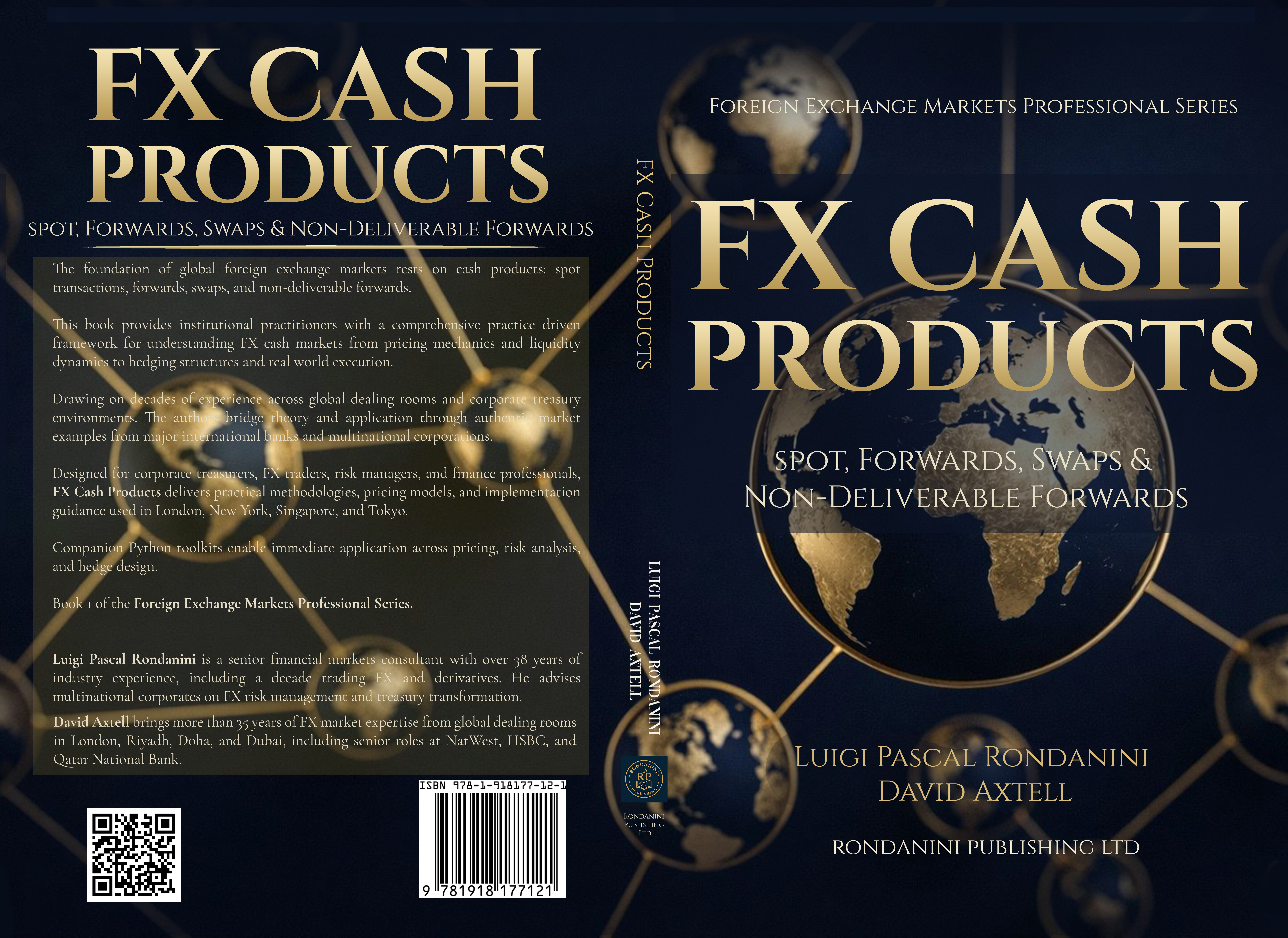
FX Cash Products: Spot, Forwards, Swaps & Non-Deliverable Forwards
Practitioner guide for treasury and markets
Luigi Pascal Rondanini · David Axtell · 2026 · Rondanini
Spot, forwards, swaps, and NDFs for corporate treasurers, traders, and risk managers—operations-first, institutionally framed.
- FX
- Treasury
- Risk management

Pricing and Trading Interest Rate Derivatives
A Practical Guide to Swaps
J. Hamish M. Darbyshire · 2022 · Aitch & Dee
A swaps trader’s bridge from curve building to book management: plain-vanilla and cross-currency IR swaps, risk, funding/CSA colour, and the distance between classroom models and how desks actually work. Third-edition material includes practical Python illustrations alongside the narrative.
- Fixed income
- Interest rates
- Derivatives

Modern Computational Finance
Scripting for Derivatives and xVA
Antoine Savine · Jesper Andreasen · 2021 · John Wiley & Sons
Second volume: building professional derivative scripting systems—cash-flow representation, branching, American Monte Carlo hooks, and how scripting supports xVA-style portfolio interrogation. Written for quant devs and library architects who must ship maintainable payoff DSLs.
- Derivatives
- Quantitative finance
- Risk management

Options, Futures, and Other Derivatives
Global edition
John C. Hull · 2021 · Pearson
The standard graduate-level derivatives text.
- Derivatives
- Risk management
- Quantitative finance