
John Wiley & Sons · 2011
Managing Credit Risk: The Great Challenge for Global Financial Markets
Edward I. Altman · John Caouette · Paul Narayanan
Level · Intermediate
Editorial summary
Managing Credit Risk: The Great Challenge for Global Financial Markets provides an in-depth exploration of credit risk management, specifically tailored for treasurers, risk managers, and CFOs. The book delves into the intricacies of credit risk assessment, offering methodologies that are crucial for understanding and mitigating potential financial losses. It stands out in the field by combining theoretical frameworks with practical applications, making it a valuable resource alongside other titles focused on risk management.
The authors, John Caouette, Edward I. Altman, and Paul Narayanan, draw on their extensive expertise to present a structured approach to credit risk. Readers will encounter various parts that cover risk measurement techniques, the role of credit ratings, and the impact of market conditions on credit risk exposure. The book's intermediate reading level ensures that finance professionals can engage with the material effectively, regardless of their prior knowledge.
Mathematical concepts are integrated throughout the text, providing readers with the quantitative tools necessary for robust credit risk analysis. Risk teams can utilise this resource to enhance their understanding of credit derivatives, securitisation, and portfolio management, thereby improving their decision-making processes in real-time market environments.
The book also addresses regulatory considerations, which are increasingly relevant in today's financial landscape. By examining the implications of regulations on credit risk management practices, it equips finance executives with the knowledge needed to navigate compliance challenges effectively.
While the book is rich in content, potential readers should be aware that it may require a foundational understanding of finance and risk management principles to fully appreciate the depth of analysis presented. Nonetheless, it remains a critical addition to any financial library focused on risk management and credit analysis.
About this book
Managing Credit Risk: The Great Challenge for Global Financial Markets is structured to guide finance professionals through the complexities of credit risk management. The book is divided into several sections that cover the theoretical underpinnings of credit risk, practical methodologies for assessment, and the implications of regulatory frameworks. Readers can expect to engage with a blend of qualitative and quantitative analyses, enabling a comprehensive understanding of credit risk dynamics.
Core technical ideas include risk measurement techniques, the significance of credit ratings, and the influence of macroeconomic factors on credit risk. The authors elucidate various models and approaches, equipping readers with the necessary tools to assess credit risk in diverse scenarios. Prerequisites for engaging with this text include a foundational knowledge of finance and an understanding of risk management principles, which will enhance the reader's ability to apply the concepts discussed.
Competency gained from this book includes the ability to evaluate credit risk exposures, implement risk management strategies, and navigate the regulatory landscape affecting credit practices. The book also addresses the practical application of credit derivatives and securitisation, making it relevant for professionals involved in portfolio management and financial analysis.
Overall, this text serves as a vital resource for those looking to deepen their understanding of credit risk in the context of global financial markets. It not only enhances theoretical knowledge but also provides practical insights that can be applied in real-world situations, making it an essential addition to the libraries of finance executives and risk managers alike.
Why it matters
Understanding credit risk is crucial for maintaining financial stability and compliance within institutions. This book provides essential frameworks and methodologies that support risk limits, pricing strategies, and regulatory compliance, enabling professionals to make informed decisions that mitigate potential financial losses.
Best for
This book is best suited for treasurers, risk managers, and CFOs seeking to enhance their understanding of credit risk management. It is also valuable for finance professionals involved in regulatory compliance and risk assessment.
Not ideal for
It may not be ideal for beginners in finance or those without a foundational understanding of risk management principles, as the content requires some prior knowledge to fully grasp the complexities discussed.
Key themes
credit-risk|risk-management|financial-markets|regulatory-compliance|quantitative-analysis|portfolio-management|credit-derivatives|securitisation|finance-executives|risk-assessment
Strengths
One of the key strengths of this book is its comprehensive approach to credit risk management, combining theoretical insights with practical applications. The authors' expertise lends credibility to the methodologies presented, making it a reliable resource for finance professionals. The structured layout allows readers to navigate complex topics easily, while the integration of quantitative techniques enhances the analytical depth of the material. Additionally, the focus on regulatory considerations ensures that readers are well-equipped to understand compliance challenges in the context of credit risk.
Limitations
A limitation of the book is that it assumes a certain level of familiarity with finance and risk management concepts, which may pose a challenge for novice readers. Some sections may delve into complex mathematical models that could be difficult for those without a strong quantitative background. Furthermore, while the book covers a broad range of topics, it may not address every nuance of credit risk management, leaving some specific areas less explored. As such, readers seeking exhaustive coverage of all aspects of credit risk may need to consult additional resources.
Related books
Shared topics with this title.
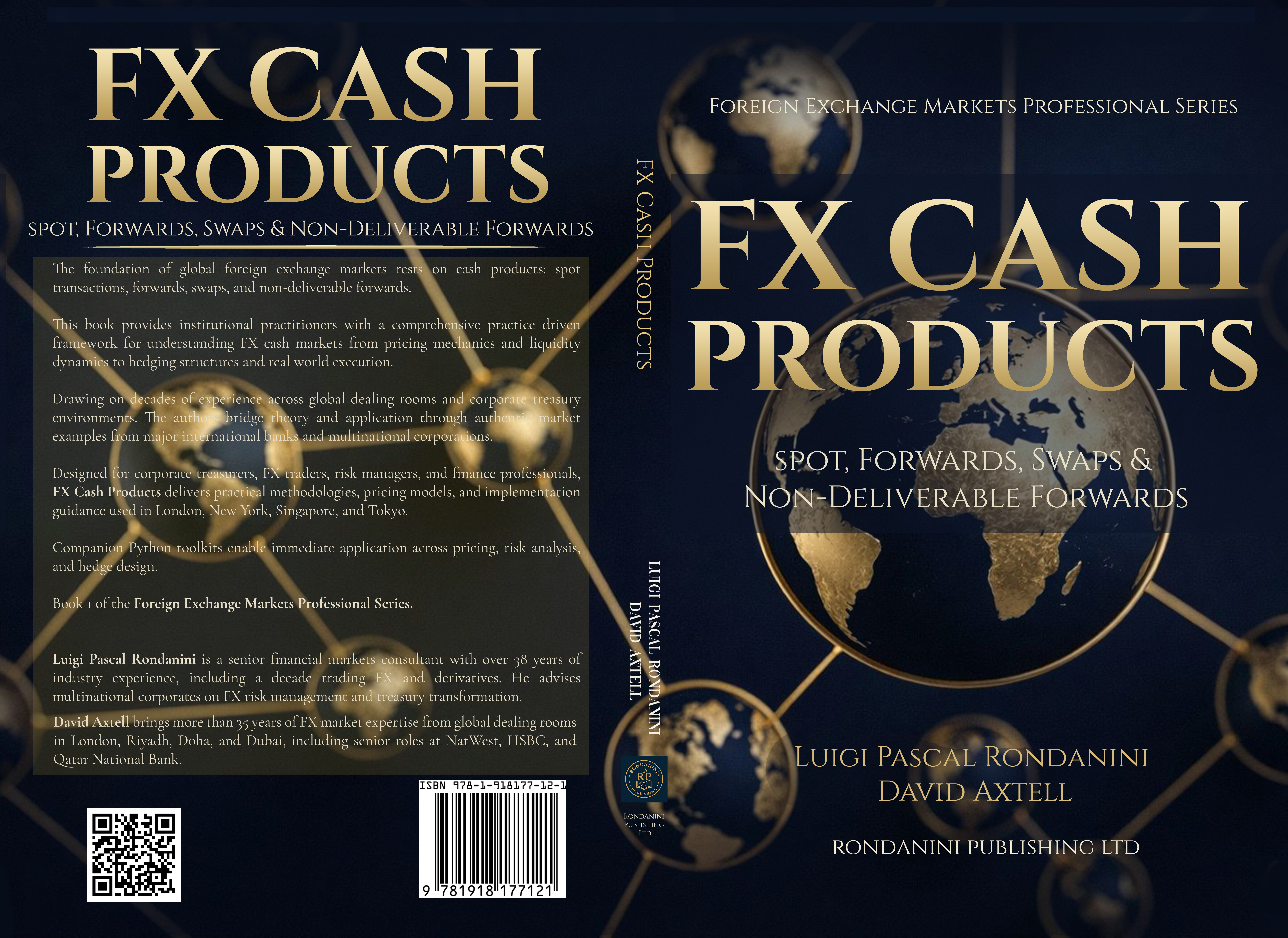
FX Cash Products: Spot, Forwards, Swaps & Non-Deliverable Forwards
Practitioner guide for treasury and markets
Luigi Pascal Rondanini · David Axtell · 2026 · Rondanini
Spot, forwards, swaps, and NDFs for corporate treasurers, traders, and risk managers—operations-first, institutionally framed.
- FX
- Treasury
- Risk management

Modern Computational Finance
Scripting for Derivatives and xVA
Antoine Savine · Jesper Andreasen · 2021 · John Wiley & Sons
Second volume: building professional derivative scripting systems—cash-flow representation, branching, American Monte Carlo hooks, and how scripting supports xVA-style portfolio interrogation. Written for quant devs and library architects who must ship maintainable payoff DSLs.
- Derivatives
- Quantitative finance
- Risk management

Options, Futures, and Other Derivatives
Global edition
John C. Hull · 2021 · Pearson
The standard graduate-level derivatives text.
- Derivatives
- Risk management
- Quantitative finance

Modern Derivatives Pricing and Credit Exposure Analysis
Lipton & Sepp · 2018 · World Scientific
This comprehensive text delves into the intricacies of modern derivatives pricing and the analysis of credit exposure. It is tailored for professionals in risk management and quantitative finance, providing a robust framework for understanding the valuation of derivatives in the context of credit risk.
- Derivatives
- Credit
- Quantitative finance