
John Wiley & Sons · 2010
FX Options and Smile Risk
Level · Institutional / advanced
Editorial summary
FX Options and Smile Risk stands out as a critical resource for finance professionals engaged in foreign exchange options trading. Unlike adjacent titles that may focus solely on theoretical aspects, this book integrates practical insights with rigorous mathematical frameworks, making it indispensable for both traders and risk managers. The text delves into various FX options products, providing detailed methodologies for pricing and risk assessment, which are crucial for effective trading strategies.
The book is structured to guide readers through the complexities of FX volatility surface construction, addressing key market conventions and the nuances of pricing vanilla and barrier options. It also emphasizes the importance of calibration techniques, which are often overlooked in other literature, ensuring that practitioners can apply theoretical models to real-world scenarios effectively. Readers will encounter a blend of stochastic and local volatility models, alongside innovative numerical methods for calibration, enhancing their quantitative skills in FX markets.
Mathematically, the book covers advanced topics such as partial differential equations and Fourier transform methods, catering to an institutional reading level. This depth of content equips readers with the ability to tackle sophisticated pricing challenges and understand the implications of smile risk in their trading operations. Treasury and risk teams will find the methodologies presented here particularly relevant for managing exposure and ensuring compliance with market standards.
Despite its strengths, the book may present challenges for those without a solid foundation in quantitative finance, as it assumes a degree of familiarity with complex mathematical concepts. However, its practical focus and real-world applications make it a valuable addition to the libraries of finance professionals.
In summary, FX Options and Smile Risk is an essential guide that connects rigorous theory with practical application, making it a must-read for anyone involved in the FX options market.
About this book
FX Options and Smile Risk is a meticulously crafted text that serves as a definitive guide to foreign exchange options, focusing on the intricacies of volatility surfaces and smile risk. The book is structured to provide a thorough understanding of the mathematical foundations necessary for pricing and managing FX options, making it particularly suitable for practitioners in trading and risk management roles. Readers can expect to engage with a wide array of topics, including the construction of FX volatility surfaces, the pricing of various options, and the calibration of models used in the industry.
The core technical ideas presented in this book encompass advanced mathematical techniques such as partial differential equations, Fourier transform methods, and stochastic volatility models. These concepts are not merely theoretical; they are contextualised within the realities of the financial marketplace, ensuring that readers can apply their knowledge directly to their work. The author, Antonio Castagna, integrates practical examples and real-world data to illustrate the application of these methods, providing a comprehensive learning experience.
Prerequisites for readers include a solid grounding in quantitative finance and familiarity with derivatives markets. The book assumes that readers are equipped to handle complex mathematical formulations and are seeking to deepen their understanding of FX options pricing and risk management. By the end of the text, practitioners will have developed competencies in both the theoretical and practical aspects of FX options, enabling them to navigate the challenges of the market with confidence.
In addition to its focus on pricing and calibration, FX Options and Smile Risk highlights the significance of smile risk and its implications for trading strategies. The book addresses the calibration techniques necessary for accurately pricing path-dependent options, which are often critical for managing risk in volatile markets. This comprehensive approach ensures that readers are not only aware of the theoretical underpinnings but also equipped with the tools needed to implement these concepts in practice.
Why it matters
FX Options and Smile Risk is pivotal for market professionals, as it directly informs workflows related to pricing, risk assessment, and compliance within the FX options market. Understanding the intricacies of volatility surfaces and smile risk allows traders and risk managers to make informed decisions that align with market dynamics and regulatory requirements.
Best for
This book is best suited for traders, risk managers, and quantitative analysts who are involved in foreign exchange options and seek to enhance their understanding of pricing and risk management techniques. It is also valuable for financial professionals looking to deepen their quantitative skills in derivatives markets.
Not ideal for
It may not be ideal for beginners in finance or those without a strong mathematical background, as the content assumes familiarity with advanced quantitative concepts and may be challenging for those new to the field.
Key themes
fx-options|smile-risk|volatility-surface|pricing|calibration|stochastic-models|risk-management|quantitative-finance|derivatives|financial-markets
Strengths
One of the primary strengths of FX Options and Smile Risk is its comprehensive coverage of both theoretical and practical aspects of FX options trading. The integration of real-world examples and data enhances the learning experience, making complex mathematical concepts accessible and applicable. The book's focus on calibration techniques is particularly noteworthy, as it addresses a critical area often neglected in other texts, thereby equipping practitioners with the necessary tools to implement models effectively in their trading strategies. Additionally, the author's expertise in the field ensures that the content is relevant and aligned with current market practices.
Limitations
While the book excels in providing a detailed and technical treatment of FX options, its complexity may pose challenges for readers lacking a strong foundation in quantitative finance. The institutional reading level may deter less experienced practitioners, and the depth of mathematical detail could be overwhelming for those new to the subject. Furthermore, while the book covers a wide range of topics, it may not delve deeply into specific case studies or practical applications beyond the theoretical frameworks, limiting its utility for readers seeking more hands-on guidance.
Related books
Shared topics with this title.
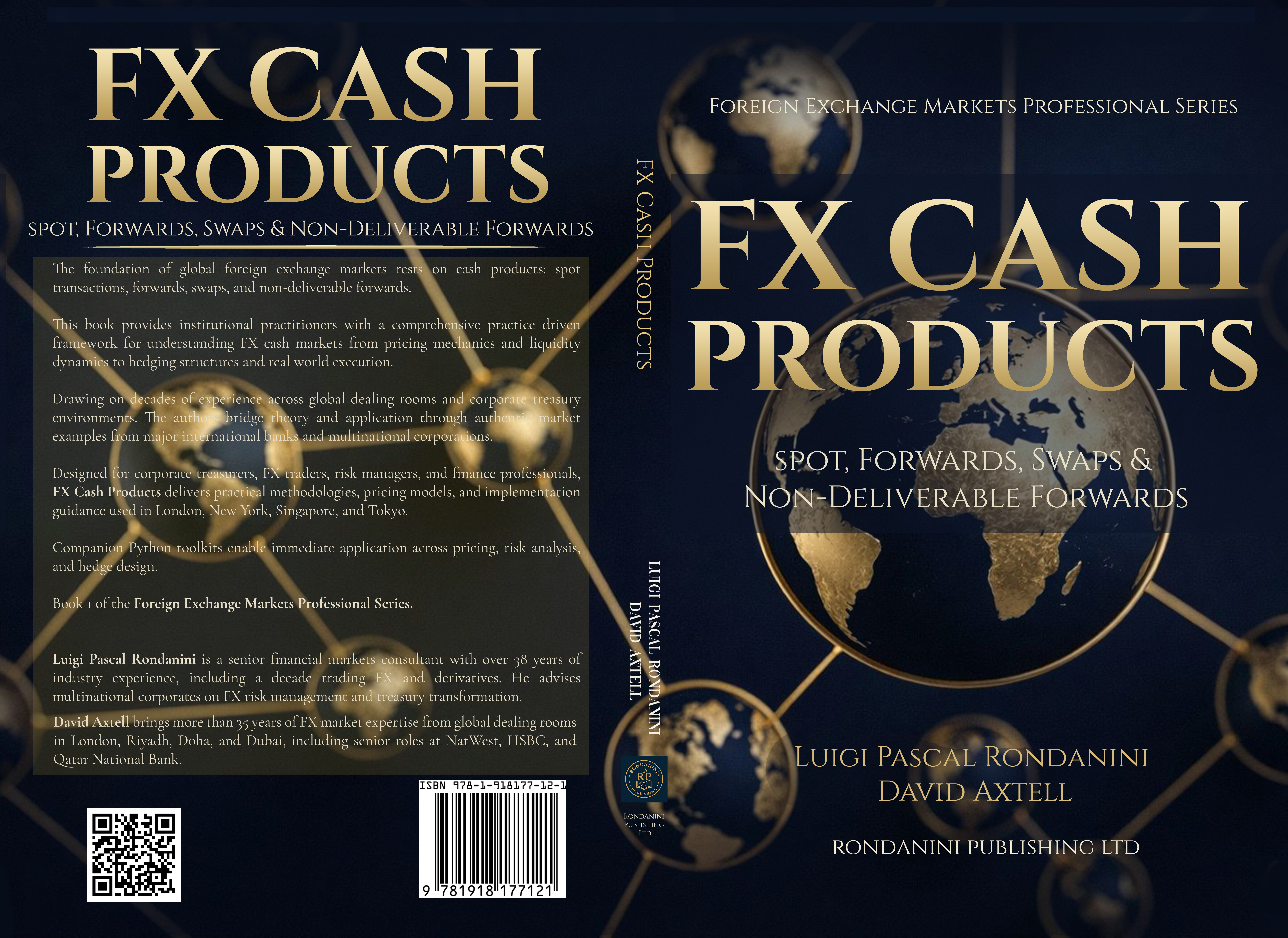
FX Cash Products: Spot, Forwards, Swaps & Non-Deliverable Forwards
Practitioner guide for treasury and markets
Luigi Pascal Rondanini · David Axtell · 2026 · Rondanini
Spot, forwards, swaps, and NDFs for corporate treasurers, traders, and risk managers—operations-first, institutionally framed.
- FX
- Treasury
- Risk management

Pricing and Trading Interest Rate Derivatives
A Practical Guide to Swaps
J. Hamish M. Darbyshire · 2022 · Aitch & Dee
A swaps trader’s bridge from curve building to book management: plain-vanilla and cross-currency IR swaps, risk, funding/CSA colour, and the distance between classroom models and how desks actually work. Third-edition material includes practical Python illustrations alongside the narrative.
- Derivatives
- Fixed income
- Interest rates

Options, Futures, and Other Derivatives
Global edition
John C. Hull · 2021 · Pearson
The standard graduate-level derivatives text.
- Derivatives
- Risk management
- Quantitative finance

Modern Computational Finance
Scripting for Derivatives and xVA
Antoine Savine · Jesper Andreasen · 2021 · John Wiley & Sons
Second volume: building professional derivative scripting systems—cash-flow representation, branching, American Monte Carlo hooks, and how scripting supports xVA-style portfolio interrogation. Written for quant devs and library architects who must ship maintainable payoff DSLs.
- Derivatives
- Risk management
- Quantitative finance