
John Wiley & Sons · 2015
FX Derivatives Trader School
Level · Intermediate
Editorial summary
Jewitt’s book is catalogued here as a pedagogical FX derivatives primer, not as a substitute for Castagna, Clark, Wystup, or Lipton-class references that institutional vol desks keep within arm’s reach. Its strength is pacing and repetition: forwards, vanilla options, smile intuition, and practical hedging language are introduced with classroom discipline and exercises that help newcomers convert jargon into mental models.
The Wiley Trading packaging signals a mid-level practitioner textbook aimed at junior traders, interns, MSc conversion students, and educators preparing cohorts for dealing-room interviews. The tone is encouraging and methodical; it spends time on how practitioners talk about risk and scenarios before pushing into heavy mathematics.
Mathematical depth is moderate. Readers meet the standard FX options toolkit (delta, gamma, vega narratives, smile sketches) but should not expect a complete stochastic-volatility calibration treatise or microstructure-level treatment of modern e-FX venues. That restraint is appropriate for the target reader but is a hard ceiling for seniors.
Corporate treasury and “Learn” audiences can use the book to demystify dealer dialogue around hedging structures, even if they never price exotics internally. It pairs well with broader FX cash and risk titles on this shelf when the goal is explainability, not proprietary strategy research.
Candid shelf note: publication in 2015 means post-2016 market structure, regulation, and platform evolution are background noise rather than foreground topics. Experienced professionals will notice dated examples and tooling; the value for them is mainly as training collateral, not as an up-to-date microstructure source.
About this book
The book is structured as a progressive course: foundational spot/forward relationships, then vanilla options, then increasingly applied topics such as volatility quoting conventions and practical hedging scenarios. Excel practicals anchor many chapters, which suits academic or in-house programmes that still teach with spreadsheets before graduating to vendor systems.
Risk explanations emphasise Greek narratives and scenario thinking familiar to junior desks rather than formal PDE derivations. That choice improves accessibility for career switchers but limits usefulness as a quant reference.
Readers should enter with basic calculus and probability and a willingness to work problems. After working cover-to-cover, a junior should hold smoother conversations with FX sales and trading on vanilla structures and risk, yet still require mentorship before touching complex exotics or electronic execution strategy.
For curriculum designers (universities, bank academies, Learn.Rondanini-style pathways), the book offers a single-volume spine that can be supplemented with current articles on e-FX and post-Brexit liquidity episodes to update context without replacing the core lessons.
Why it matters
FX derivatives literacy remains a bottleneck for treasury, risk, and early-career markets programmes. Not every reader needs Lipton-level mathematics on day one; credible intuition and vocabulary prevent expensive misunderstandings when structures are sold. This title earns its place as training infrastructure, provided the catalogue does not oversell it as state-of-the-art vol engineering.
Best for
Students, interns, and junior analysts entering FX options desks; career switchers needing structured drills; trainers building introductory vol curricula; treasury professionals who must understand dealer speak on vanilla hedges without becoming quants; content authors who need a patient reference for explaining FX option basics clearly.
Not ideal for
Experienced FX vol traders and structurers seeking advanced smile models, electronic liquidity microstructure, or post-2016 market-structure detail—use Clark, Castagna, or current sell-side research instead. Quantitative researchers building stochastic-vol calibration stacks will find the mathematics too light. Anyone expecting cutting-edge e-FX execution content should plan on supplementary readings.
Key themes
fx-options|introductory-training|volatility-intuition|greeks-narratives|excel-practicals|junior-traders|treasury-literacy|teaching-curriculum|vanilla-structures|worked-examples
Strengths
Deliberate teaching cadence with repeated intuition checks. Broad coverage of vanilla FX derivatives vocabulary in one place. Excel-centred exercises suit classrooms and self-study with immediate feedback. Accessible prose lowers the barrier for non-native English finance learners compared with denser institutional monographs.
Limitations
Not current on market structure post-mid-2010s; seniors will outpace it quickly. Maths and model depth trail specialist FX vol texts. Excel reliance can mislead if teams never graduate to production-grade curves and systems. It should not be positioned as a peer to advanced practitioner references—doing so would mis-set reader expectations.
Related books
Shared topics with this title.
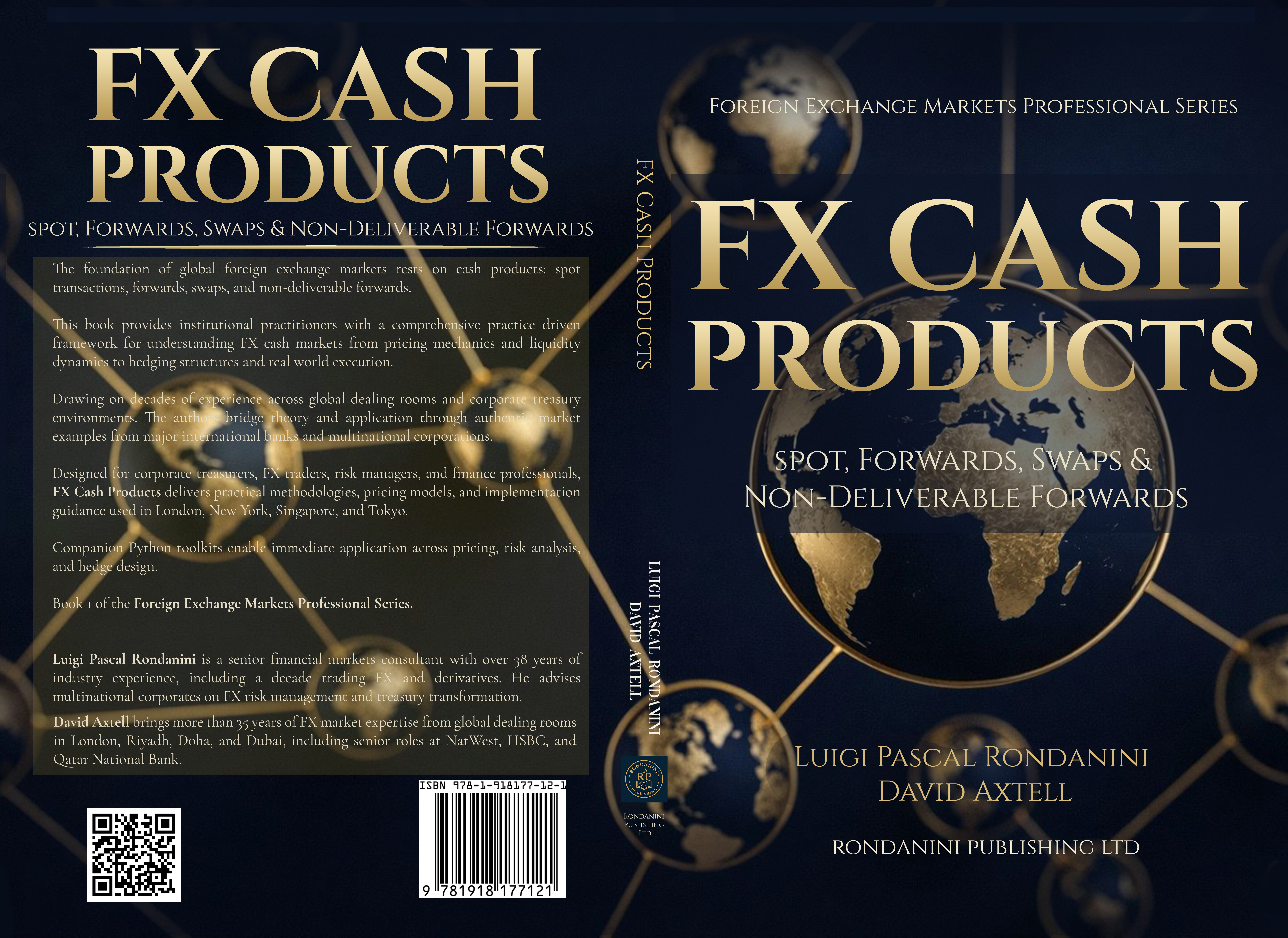
FX Cash Products: Spot, Forwards, Swaps & Non-Deliverable Forwards
Practitioner guide for treasury and markets
Luigi Pascal Rondanini · David Axtell · 2026 · Rondanini
Spot, forwards, swaps, and NDFs for corporate treasurers, traders, and risk managers—operations-first, institutionally framed.
- FX
- Treasury
- Risk management

Pricing and Trading Interest Rate Derivatives
A Practical Guide to Swaps
J. Hamish M. Darbyshire · 2022 · Aitch & Dee
A swaps trader’s bridge from curve building to book management: plain-vanilla and cross-currency IR swaps, risk, funding/CSA colour, and the distance between classroom models and how desks actually work. Third-edition material includes practical Python illustrations alongside the narrative.
- Derivatives
- Fixed income
- Interest rates

Options, Futures, and Other Derivatives
Global edition
John C. Hull · 2021 · Pearson
The standard graduate-level derivatives text.
- Derivatives
- Risk management
- Quantitative finance

Modern Computational Finance
Scripting for Derivatives and xVA
Antoine Savine · Jesper Andreasen · 2021 · John Wiley & Sons
Second volume: building professional derivative scripting systems—cash-flow representation, branching, American Monte Carlo hooks, and how scripting supports xVA-style portfolio interrogation. Written for quant devs and library architects who must ship maintainable payoff DSLs.
- Derivatives
- Risk management
- Quantitative finance