
Financial Analysts Journal · 1983
The Garman-Kohlhagen Model for Foreign Currency Options
Mark B. Garman · Steven W. Kohlhagen
Level · Practitioner
Editorial summary
The Garman-Kohlhagen Model for Foreign Currency Options is a seminal work that provides an in-depth examination of the valuation of foreign currency options, utilising a quantitative approach that is essential for traders and quants alike. The authors, Mark B. Garman and Steven W. Kohlhagen, introduce a model that extends the Black-Scholes framework to the foreign exchange market, addressing the unique characteristics of currency options. This text is positioned alongside other foundational works in quantitative finance, yet it stands out due to its specific focus on FX derivatives.
Readers will navigate through the intricacies of the Garman-Kohlhagen model, which encompasses various components such as interest rate differentials, volatility, and the dynamics of currency pairs. The book is structured to guide practitioners through the mathematical formulations and assumptions underlying the model, making it accessible for those with a solid grounding in finance and mathematics. The text also discusses the implications of market conditions on option pricing, providing practical insights for real-world application.
The mathematical detail is significant, requiring readers to have a firm understanding of stochastic processes and derivatives pricing. Desk teams focused on FX trading will find the model particularly useful for pricing and hedging currency options, while risk teams can leverage its insights to assess exposure and manage risk limits effectively. The emphasis on quantitative methods makes this book a critical resource for those engaged in the analytical aspects of FX markets.
Despite its strengths, the evidence in the text may be limited in terms of contemporary applications or examples, which could leave some readers seeking additional context or case studies. However, the foundational principles presented remain relevant for understanding modern FX option pricing.
Overall, this work is an essential addition to the library of any finance professional involved in FX derivatives, offering both theoretical and practical perspectives on the Garman-Kohlhagen model.
About this book
The Garman-Kohlhagen Model for Foreign Currency Options is structured to provide a detailed exploration of the valuation of currency options, a critical area within the field of derivatives. The book begins with an introduction to the fundamental concepts of foreign exchange markets and the unique characteristics that differentiate currency options from other financial derivatives. It then delves into the mathematical framework of the Garman-Kohlhagen model, which adapts the Black-Scholes model to account for the complexities of FX options.
Core technical ideas presented include the treatment of interest rate differentials between currencies, the role of volatility in pricing, and the impact of market dynamics on option valuations. The authors meticulously outline the assumptions underlying their model, equipping readers with the necessary tools to apply these concepts in practical scenarios. The text is designed for practitioners who are expected to have a foundational understanding of quantitative finance and derivatives, making it suitable for both traders and quantitative analysts.
As readers progress through the book, they will gain competency in applying the Garman-Kohlhagen model to real-world situations, enhancing their ability to price and hedge foreign currency options effectively. The structured approach allows for a thorough understanding of the model's components and their interrelations, fostering a comprehensive grasp of FX option pricing.
While the book is rich in mathematical detail and practical applications, it may require supplementary resources for those unfamiliar with advanced quantitative methods. Nevertheless, it serves as a vital reference for finance professionals seeking to deepen their expertise in FX derivatives and quantitative analysis.
Why it matters
Understanding the Garman-Kohlhagen model is crucial for finance professionals engaged in FX trading and derivatives, as it directly impacts pricing strategies, risk management, and compliance with regulatory frameworks. The insights gained from this model can enhance decision-making processes related to currency options, ultimately influencing trading performance and risk exposure.
Best for
This book is best suited for traders and quantitative analysts working in foreign exchange markets, as well as finance professionals seeking to deepen their understanding of FX derivatives and quantitative pricing models.
Not ideal for
It may not be ideal for beginners in finance or those without a solid mathematical background, as the text requires familiarity with quantitative finance concepts and derivatives pricing.
Key themes
foreign-exchange|currency-options|quantitative-finance|derivatives-pricing|risk-management|financial-models|stochastic-processes|market-dynamics|interest-rate-differentials
Strengths
The primary strength of The Garman-Kohlhagen Model for Foreign Currency Options lies in its rigorous mathematical framework and practical applicability to FX derivatives. The authors provide a clear and structured approach to understanding the valuation of currency options, making it a valuable resource for practitioners. The model's adaptation of the Black-Scholes framework to the FX market is particularly noteworthy, as it addresses the unique challenges faced by traders in this domain. Additionally, the book's focus on quantitative methods equips readers with essential tools for effective pricing and risk assessment.
Limitations
One limitation of the text is its potential lack of contemporary examples or case studies that illustrate the model's application in today's rapidly evolving FX markets. While the foundational principles are robust, readers may find themselves seeking additional context or updates on market practices. Furthermore, the mathematical detail may pose challenges for those who are not well-versed in advanced quantitative techniques, potentially limiting its accessibility to a broader audience.
Related books
Shared topics with this title.
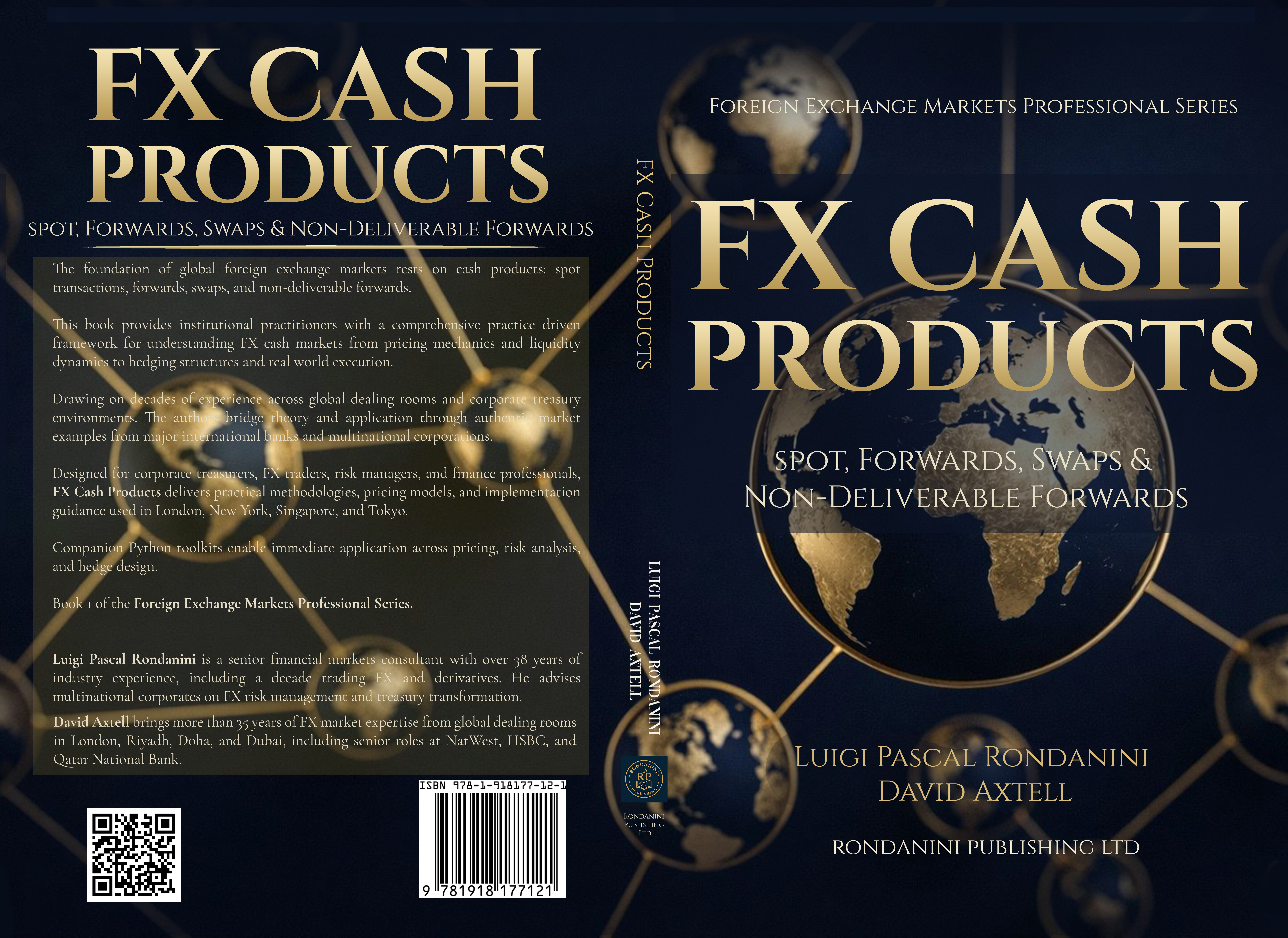
FX Cash Products: Spot, Forwards, Swaps & Non-Deliverable Forwards
Practitioner guide for treasury and markets
Luigi Pascal Rondanini · David Axtell · 2026 · Rondanini
Spot, forwards, swaps, and NDFs for corporate treasurers, traders, and risk managers—operations-first, institutionally framed.
- FX
- Treasury
- Risk management

Pricing and Trading Interest Rate Derivatives
A Practical Guide to Swaps
J. Hamish M. Darbyshire · 2022 · Aitch & Dee
A swaps trader’s bridge from curve building to book management: plain-vanilla and cross-currency IR swaps, risk, funding/CSA colour, and the distance between classroom models and how desks actually work. Third-edition material includes practical Python illustrations alongside the narrative.
- Fixed income
- Interest rates
- Derivatives

Modern Computational Finance
Scripting for Derivatives and xVA
Antoine Savine · Jesper Andreasen · 2021 · John Wiley & Sons
Second volume: building professional derivative scripting systems—cash-flow representation, branching, American Monte Carlo hooks, and how scripting supports xVA-style portfolio interrogation. Written for quant devs and library architects who must ship maintainable payoff DSLs.
- Derivatives
- Quantitative finance
- Risk management

Options, Futures, and Other Derivatives
Global edition
John C. Hull · 2021 · Pearson
The standard graduate-level derivatives text.
- Derivatives
- Risk management
- Quantitative finance