
Boj · 2005
Expected Shortfall as a Performance Measure
Hiroshi Yoshiba · Yoshitaka Yamai
Level · Practitioner
Editorial summary
Expected Shortfall as a Performance Measure by Yoshitaka Yamai and Hiroshi Yoshiba offers a focused examination of expected shortfall (ES) and its application in risk management. This book stands out on the shelf for its practical approach, catering specifically to risk managers and quantitative analysts who require a deeper understanding of performance metrics beyond traditional measures like Value at Risk (VaR).
The authors delve into the mathematical foundations of expected shortfall, detailing its calculation and the rationale for its use as a risk measure. The text is structured to guide readers through the theoretical underpinnings of ES, providing practical examples and applications that are relevant to daily risk management tasks. This includes discussions on how ES can be integrated into performance evaluation frameworks, making it a valuable resource for those involved in risk assessment and financial decision-making.
With a practitioner-level reading requirement, the book balances technical detail with accessibility, ensuring that readers can effectively apply the concepts discussed. The mathematical rigor is appropriate for professionals familiar with quantitative finance, while the clear explanations make it suitable for those looking to enhance their understanding of risk metrics.
Risk teams and treasury operations can leverage the insights from this book to refine their risk assessment processes and improve compliance with regulatory standards. By adopting expected shortfall as a performance measure, firms can better align their risk management practices with their strategic objectives.
While the book is comprehensive in its approach to expected shortfall, it may not cover broader risk management frameworks or alternative performance measures extensively. Readers seeking a more holistic view of risk management practices may need to consult additional resources to complement the insights provided here.
About this book
Expected Shortfall as a Performance Measure is a focused exploration of the expected shortfall (ES) metric, a critical tool in the field of risk management. The authors, Yoshitaka Yamai and Hiroshi Yoshiba, provide a structured analysis of ES, detailing its mathematical formulation and the theoretical rationale behind its adoption as a performance measure. The book is designed for practitioners, particularly those in risk management and quantitative finance, who seek to deepen their understanding of this important concept.
The text begins with an introduction to the limitations of traditional risk measures, such as Value at Risk (VaR), and positions expected shortfall as a more robust alternative. The authors meticulously outline the calculation of ES, illustrating its application in various financial contexts. Readers will find practical examples that demonstrate how expected shortfall can be employed to assess risk exposure and evaluate performance, making it a relevant resource for daily operations in risk management.
Throughout the book, the authors maintain a balance between mathematical rigor and practical applicability, ensuring that the content is accessible to those with a foundational understanding of quantitative finance. The discussions are enriched with insights into how expected shortfall can be integrated into existing risk management frameworks, thereby enhancing the decision-making process for risk managers and treasury professionals.
Competency gained from this book includes a solid grasp of expected shortfall as a performance measure, the ability to calculate and interpret ES, and an understanding of its implications for risk management strategies. Readers will be equipped to apply these concepts in real-world scenarios, improving their ability to manage risk effectively and comply with regulatory requirements.
Why it matters
Understanding expected shortfall is crucial for risk managers as it provides a more comprehensive view of potential losses compared to traditional measures like VaR. By implementing ES as a performance measure, firms can enhance their risk assessment frameworks, ensuring better alignment with regulatory standards and more informed financial decision-making.
Best for
This book is best suited for risk managers, quantitative analysts, and finance professionals who are looking to deepen their understanding of performance measures in risk management. It is particularly useful for those involved in developing and implementing risk assessment frameworks.
Not ideal for
It may not be ideal for beginners in finance or those seeking a broad overview of risk management practices, as the content is more focused on the specific application of expected shortfall rather than a comprehensive risk management curriculum.
Key themes
expected-shortfall|risk-management|quantitative-finance|performance-measure|financial-decision-making
Strengths
One of the key strengths of this book is its focused approach to expected shortfall, providing a clear and concise exploration of the topic. The authors effectively bridge the gap between theory and practice, ensuring that readers can apply the concepts in real-world scenarios. Additionally, the mathematical detail is well-balanced with practical examples, making it accessible to practitioners with varying levels of expertise in quantitative finance.
Limitations
A notable limitation of the book is its narrow focus on expected shortfall, which may leave readers seeking a broader understanding of risk management frameworks wanting more. While it provides in-depth insights into ES, it does not extensively cover alternative performance measures or the wider context of risk management practices. As such, readers may need to supplement their learning with additional resources to gain a comprehensive view of the field.
Related books
Shared topics with this title.
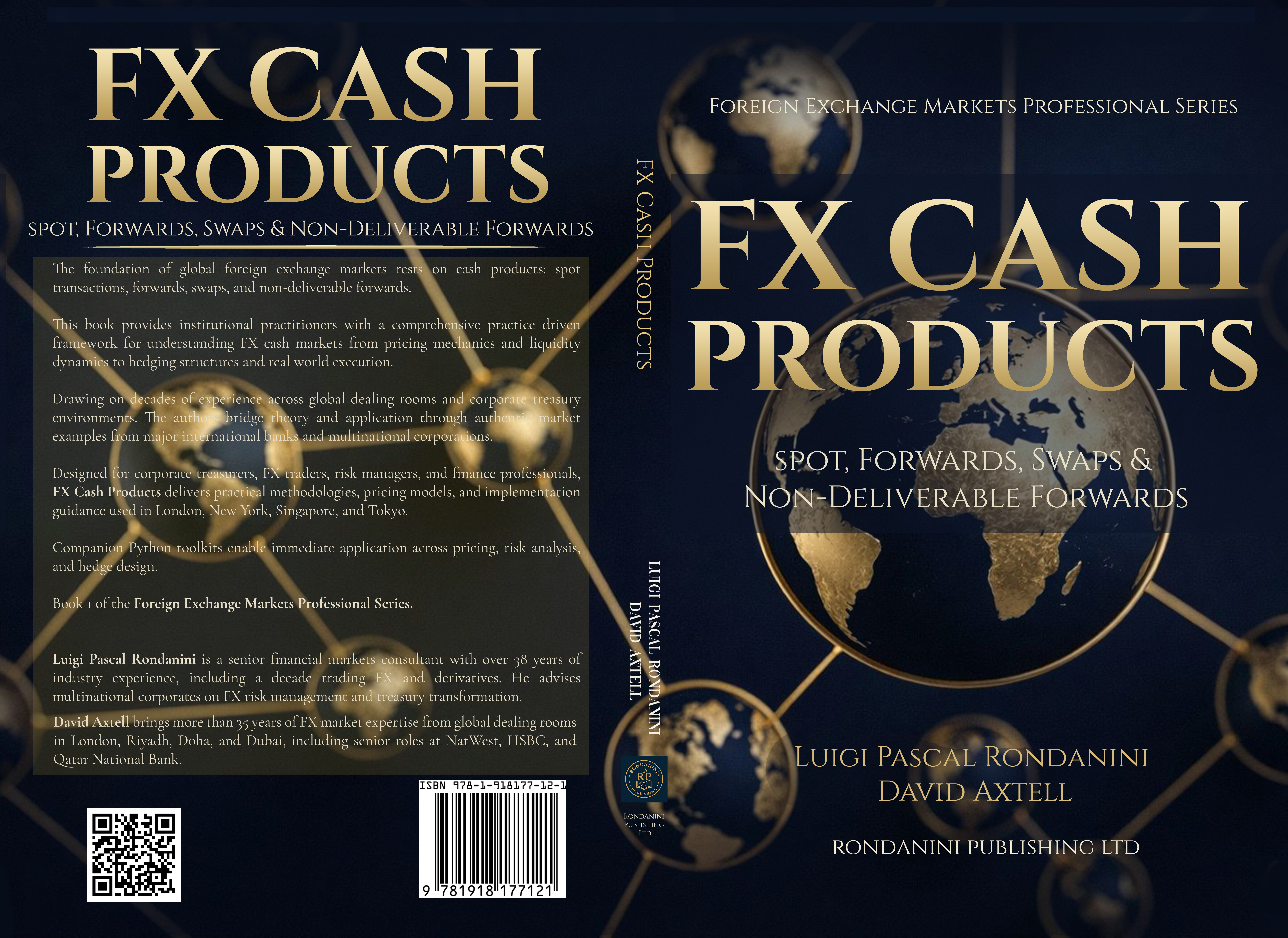
FX Cash Products: Spot, Forwards, Swaps & Non-Deliverable Forwards
Practitioner guide for treasury and markets
Luigi Pascal Rondanini · David Axtell · 2026 · Rondanini
Spot, forwards, swaps, and NDFs for corporate treasurers, traders, and risk managers—operations-first, institutionally framed.
- FX
- Treasury
- Risk management

Modern Computational Finance
Scripting for Derivatives and xVA
Antoine Savine · Jesper Andreasen · 2021 · John Wiley & Sons
Second volume: building professional derivative scripting systems—cash-flow representation, branching, American Monte Carlo hooks, and how scripting supports xVA-style portfolio interrogation. Written for quant devs and library architects who must ship maintainable payoff DSLs.
- Derivatives
- Quantitative finance
- Risk management

Options, Futures, and Other Derivatives
Global edition
John C. Hull · 2021 · Pearson
The standard graduate-level derivatives text.
- Derivatives
- Risk management
- Quantitative finance

High Performance Computing: Modern Systems and Applications
Michael Gorelick · Iman Ozsvald · 2019 · O Reilly
This comprehensive volume delves into high-performance computing (HPC) systems and their applications, particularly in quantitative finance and technology. It covers modern architectures, programming models, and performance optimization techniques essential for practitioners in the field.
- Technology
- Quantitative finance