
Imf · 2012
Commodity-Linked Currencies: How Do They Behave?
Level · Intermediate
Editorial summary
Commodity-Linked Currencies: How Do They Behave? offers a comprehensive analysis of the relationship between currencies and commodities, focusing on how fluctuations in commodity prices impact currency valuations. This title is positioned alongside other macroeconomic and FX-focused texts, providing a unique perspective on the interplay between these two critical areas. The authors employ a blend of theoretical frameworks and empirical data to elucidate the mechanisms at play, making it a valuable resource for practitioners in the field.
The book is structured to guide readers through the complexities of commodity-linked currencies, addressing key themes such as price elasticity, market sentiment, and the role of macroeconomic indicators. Readers will engage with quantitative methods and case studies that highlight real-world applications, enabling them to grasp the nuances of currency behaviour in response to commodity market shifts. The intermediate reading level suggests that a foundational understanding of both foreign exchange and macroeconomic principles is beneficial.
Macro traders and fund managers will find this work particularly useful as it provides actionable insights into how commodity price movements can influence currency strategies. The book discusses various scenarios and their implications for trading and investment decisions, making it a practical guide for those actively engaged in these markets. Additionally, the analytical frameworks presented can assist in developing risk management strategies tailored to commodity-linked exposures.
While the evidence provided is robust, readers should be aware that the depth of analysis may vary across different sections. The book excels in its exploration of theoretical concepts but may not delve as deeply into specific case studies as some practitioners might desire. Nonetheless, it remains a significant contribution to the literature on FX and commodities, particularly for those looking to enhance their understanding of these interconnected domains.
About this book
Commodity-Linked Currencies: How Do They Behave? is structured to provide an in-depth exploration of the intricate relationship between currencies and commodities. The authors, Cashin et al., employ a mix of theoretical analysis and empirical evidence to dissect how commodity price fluctuations can influence currency valuations. This examination is particularly relevant in the context of macroeconomic trends and foreign exchange dynamics, making it a critical read for professionals in these fields.
The book begins with foundational concepts, establishing the economic principles that underpin the behaviour of commodity-linked currencies. It then progresses to more complex analyses, including the elasticity of demand for commodities and the impact of global market sentiment on currency fluctuations. Readers can expect to engage with quantitative methods that enhance their understanding of the statistical relationships between commodity prices and currency movements.
Competency gained from this text includes the ability to analyse and interpret the effects of commodity price changes on currency markets, equipping readers with the tools necessary for informed trading and investment decisions. The intermediate level of reading suggests that a prior understanding of macroeconomic principles and foreign exchange mechanics will be advantageous for fully grasping the material presented.
As a resource, this book serves as a guide for macro traders and fund managers, offering practical insights that can be applied to real-world trading strategies. The analytical frameworks discussed within the text provide a basis for developing risk management practices tailored to the unique challenges posed by commodity-linked currencies. Overall, this publication stands out as a significant contribution to the understanding of the interplay between commodities and foreign exchange.
Why it matters
Understanding the behaviour of commodity-linked currencies is crucial for market professionals involved in risk management, pricing strategies, and investment decision-making. As commodity prices fluctuate, so too do the currencies that are closely tied to them, impacting everything from trade balances to investment flows. This text provides the analytical tools necessary to navigate these complexities effectively.
Best for
This book is best suited for macro traders and fund managers who require a deeper understanding of the interplay between commodity prices and currency movements. It is also relevant for analysts and economists working within the FX and commodities sectors.
Not ideal for
It may not be ideal for beginners in finance or those without a foundational understanding of macroeconomic principles and foreign exchange mechanics, as the intermediate level of reading requires some prior knowledge.
Key themes
commodity-linked-currencies|foreign-exchange|macro-economics|commodity-prices|risk-management|trading-strategies|market-sentiment|empirical-analysis|quantitative-methods
Strengths
One of the key strengths of this publication is its comprehensive analysis of the relationship between commodity prices and currency valuations. The authors successfully blend theoretical insights with empirical data, providing a well-rounded perspective that is both informative and applicable to real-world scenarios. The structured approach allows readers to progressively build their understanding, making complex concepts more accessible. Additionally, the focus on practical implications for macro traders and fund managers enhances its relevance in the current market landscape.
Limitations
However, the book does have limitations, particularly in the depth of case studies presented. While it excels in theoretical exploration, some readers may find that it does not provide enough detailed examples of real-world applications to fully illustrate the concepts discussed. Furthermore, the intermediate reading level may pose challenges for those who lack a solid foundation in macroeconomic and foreign exchange principles, potentially limiting its accessibility to a broader audience.
Related books
Shared topics with this title.
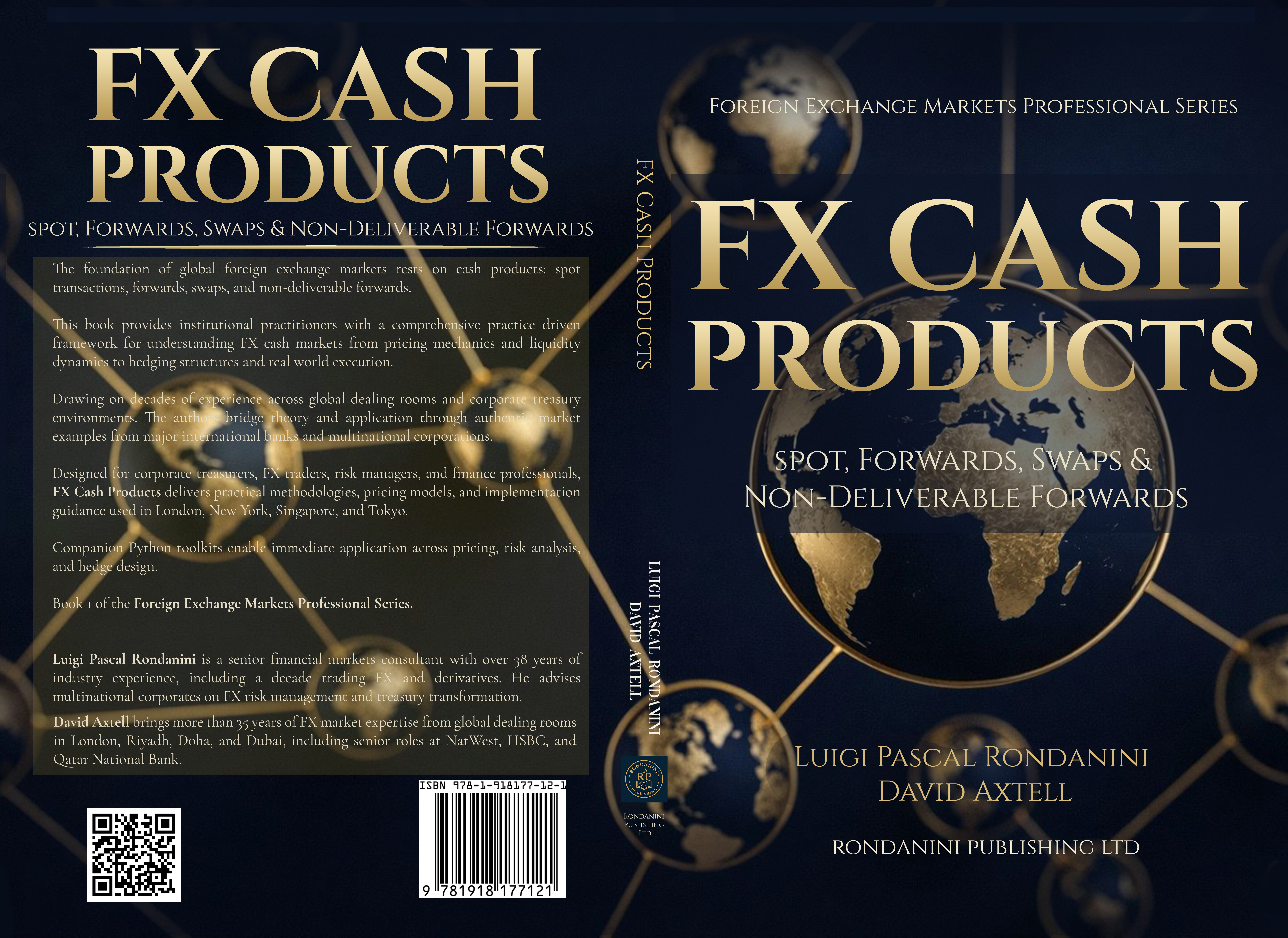
FX Cash Products: Spot, Forwards, Swaps & Non-Deliverable Forwards
Practitioner guide for treasury and markets
Luigi Pascal Rondanini · David Axtell · 2026 · Rondanini
Spot, forwards, swaps, and NDFs for corporate treasurers, traders, and risk managers—operations-first, institutionally framed.
- FX
- Treasury
- Risk management
Capitalism in America: A History
Alan Greenspan · Adrian Wooldridge · 2018 · John Wiley & Sons
Capitalism in America: A History offers a comprehensive exploration of the evolution of American capitalism, examining its historical roots, key policies, and macroeconomic impacts. Authored by Alan Greenspan and Adrian Wooldridge, this work is essential for understanding the interplay between economic systems and societal changes.
- History
- Macro
- Policy

FX Essentials: Spot, Forwards, Swaps and Non-Deliverable Forwards
Shani Shamah · 2018 · John Wiley & Sons
FX Essentials provides a comprehensive introduction to the fundamental concepts of foreign exchange markets, including spot transactions, forwards, swaps, and non-deliverable forwards. It is designed for professionals seeking to understand the mechanics and applications of FX instruments within treasury operations.
- FX
- Treasury

The Foreign Exchange Market: Theory and Practice
Owen F. Harris · Hon-Ho Kwang · 2017 · John Wiley & Sons
This comprehensive text delves into the foreign exchange market, covering both theoretical frameworks and practical applications. It addresses key concepts in market microstructure, making it essential for traders and analysts seeking to enhance their understanding of FX dynamics.
- FX
- Market microstructure