
John Wiley & Sons · 2017
The Foreign Exchange Market: Theory and Practice
Level · Intermediate
Editorial summary
The Foreign Exchange Market: Theory and Practice offers an in-depth exploration of the foreign exchange market, positioning itself as a vital resource for traders and analysts. Unlike other titles that may focus solely on theoretical aspects, this book integrates practical insights, making it particularly useful for those actively engaged in FX trading and analysis.
Readers will navigate through various parts of the book that discuss market microstructure, trading strategies, and the impact of macroeconomic factors on currency movements. The authors, Owen F. Harris and Hon-Ho Kwang, present a balanced approach that combines rigorous theoretical underpinnings with real-world applications, ensuring that readers can relate concepts to their daily trading activities.
The book is written at an intermediate reading level, making it accessible to professionals with a foundational understanding of finance and trading. It employs mathematical models and quantitative methods where necessary, allowing readers to grasp complex market behaviours while remaining grounded in practical applications.
Desk teams, particularly those focused on FX trading, will find the insights on market microstructure invaluable for developing effective trading strategies and risk management practices. The book also serves as a reference for analysts who need to interpret market signals and economic indicators that influence currency prices.
While the book is robust in its coverage, it is important to note that some sections may require prior knowledge of financial concepts, which could pose a challenge for complete novices. However, for those with some background in finance, this text provides a solid foundation for understanding the intricacies of the FX market.
About this book
The Foreign Exchange Market: Theory and Practice is structured to provide a comprehensive overview of the foreign exchange market, integrating both theoretical and practical perspectives. The book is divided into several key sections that explore the fundamental principles of FX trading, market microstructure, and the various factors influencing currency valuation.
Core technical ideas include an examination of trading mechanisms, the role of liquidity, and the impact of macroeconomic indicators on exchange rates. The authors employ mathematical models to elucidate complex concepts, making the material suitable for readers with an intermediate understanding of finance and quantitative analysis. This approach allows for a deeper comprehension of how market participants interact and how these interactions affect pricing and volatility.
Prerequisites for readers include a basic knowledge of financial markets and trading principles, as the text assumes familiarity with key concepts such as arbitrage, risk management, and economic indicators. Readers can expect to gain competency in analysing FX market dynamics, developing trading strategies, and understanding the implications of market microstructure on trading outcomes.
Overall, this book serves as a critical resource for professionals in the FX space, equipping them with the tools necessary to navigate the complexities of currency trading. It stands out as a practical guide that complements theoretical studies, making it a valuable addition to the library of any trader or analyst focused on the foreign exchange market.
Why it matters
Understanding the foreign exchange market is crucial for professionals involved in trading, risk management, and financial analysis. This book provides insights that can directly impact trading strategies, pricing decisions, and compliance with regulatory frameworks. By grasping market microstructure and the factors influencing currency movements, professionals can enhance their decision-making processes and improve their operational efficiency.
Best for
This book is best suited for traders and analysts who are looking to deepen their understanding of the foreign exchange market. It is particularly valuable for those who engage in FX trading and require a solid grasp of market microstructure and trading strategies.
Not ideal for
It may not be ideal for complete beginners in finance, as some sections assume prior knowledge of financial concepts and market dynamics. Readers without a foundational understanding of trading may find certain topics challenging.
Key themes
foreign-exchange|market-microstructure|trading-strategies|macroeconomic-factors|quantitative-analysis|risk-management|currency-valuation|financial-markets|trader-education
Strengths
The Foreign Exchange Market: Theory and Practice excels in its integration of theory and practice, making complex concepts accessible to intermediate-level professionals. The authors provide a thorough examination of market microstructure, which is often overlooked in other texts, offering valuable insights into trading behaviours and strategies. The book's structured approach allows readers to build their knowledge progressively, ensuring a comprehensive understanding of the FX market dynamics. Additionally, the use of mathematical models enhances the analytical depth, catering to readers who appreciate quantitative methods in their trading practices.
Limitations
While the book is robust in its coverage of the foreign exchange market, it may present challenges for those without a foundational knowledge of finance. Some sections are mathematically intensive, which could be daunting for readers who are not comfortable with quantitative analysis. Furthermore, the focus on intermediate-level content may limit its accessibility for complete novices, potentially necessitating supplementary resources for those at the very beginning of their financial education. Lastly, while the practical applications are well-addressed, the book may not cover every emerging trend or technology in the rapidly evolving FX landscape.
Related books
Shared topics with this title.
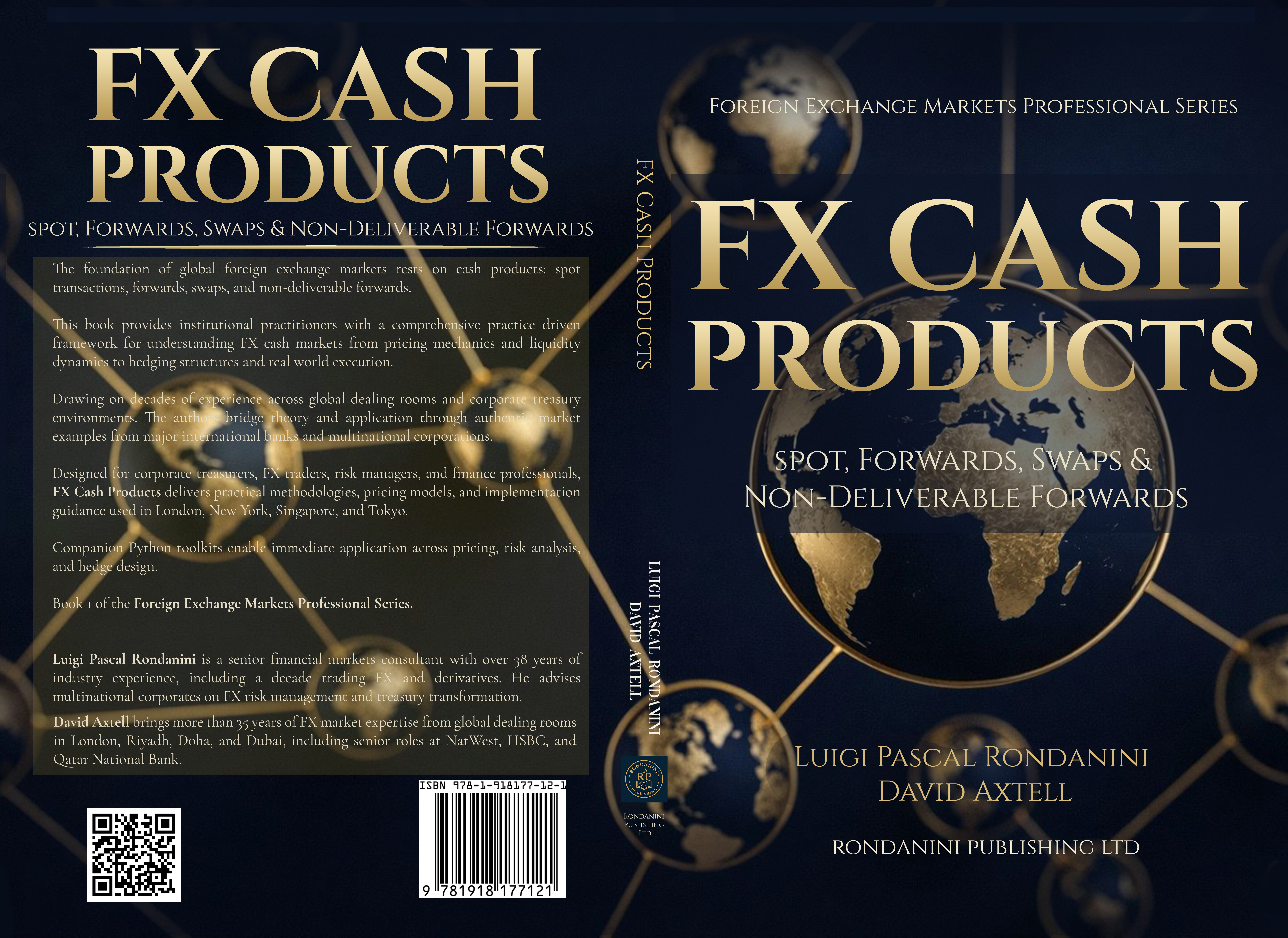
FX Cash Products: Spot, Forwards, Swaps & Non-Deliverable Forwards
Practitioner guide for treasury and markets
Luigi Pascal Rondanini · David Axtell · 2026 · Rondanini
Spot, forwards, swaps, and NDFs for corporate treasurers, traders, and risk managers—operations-first, institutionally framed.
- FX
- Treasury
- Risk management

FX Essentials: Spot, Forwards, Swaps and Non-Deliverable Forwards
Shani Shamah · 2018 · John Wiley & Sons
FX Essentials provides a comprehensive introduction to the fundamental concepts of foreign exchange markets, including spot transactions, forwards, swaps, and non-deliverable forwards. It is designed for professionals seeking to understand the mechanics and applications of FX instruments within treasury operations.
- FX
- Treasury

International Financial Management
3rd Edition
Geert Bekaert · Robert J. Hodrick · 2017 · Cambridge University Press
This comprehensive text delves into the complexities of international financial management, focusing on foreign exchange (FX) markets, treasury operations, and risk management strategies. It is designed for intermediate readers, including treasurers, analysts, and students seeking to understand the global financial landscape.
- FX
- Treasury
- Risk management

FX Options and Structured Products
2nd Edition
Uwe Wystup · 2017 · John Wiley & Sons
FX Options and Structured Products, Second Edition, by Uwe Wystup, provides an advanced exploration of non-vanilla FX options strategies and structured products. This comprehensive resource is designed for traders, analysts, and risk managers seeking to deepen their understanding of the FX derivatives market through practical case studies and exercises.
- FX
- Derivatives