
John Wiley & Sons · 2007
The Black Swan: The Impact of the Highly Improbable
Level · Introductory
Editorial summary
In 'The Black Swan: The Impact of the Highly Improbable', Nassim Nicholas Taleb presents a compelling examination of how rare, high-impact events—termed 'Black Swans'—shape our world, particularly in financial contexts. This book is positioned alongside other influential works in risk management and behavioural finance, offering a unique perspective that challenges conventional wisdom and encourages critical thinking about uncertainty.
Taleb systematically explores the limitations of standard statistical models and the dangers of over-reliance on historical data. He introduces readers to concepts such as 'anti-fragility' and the importance of acknowledging the unpredictable nature of markets. The book is structured around a series of engaging anecdotes and philosophical reflections, making complex ideas accessible to traders, students, and investors alike.
The mathematical rigor is tempered by a narrative style that prioritises understanding over technical jargon, making it suitable for an introductory reading level. Taleb's insights are particularly valuable for risk management teams, who must navigate the complexities of market volatility and the implications of unforeseen events on their strategies.
While the book is rich in thought-provoking ideas, it also serves as a cautionary tale about the limits of human foresight. Readers are encouraged to rethink their approaches to risk and uncertainty, fostering a mindset that is more adaptable to the unpredictable nature of financial markets.
Despite its popularity, the book's philosophical underpinnings may not resonate with all practitioners, particularly those seeking straightforward quantitative methods. However, for those willing to engage with its deeper themes, 'The Black Swan' offers a transformative perspective on risk and decision-making in an uncertain world.
About this book
Nassim Nicholas Taleb's 'The Black Swan: The Impact of the Highly Improbable' is a seminal work that delves into the nature of unpredictable events, which Taleb terms 'Black Swans'. The book is structured into three parts: the first defines the concept of Black Swans and their significance in various domains, particularly finance; the second critiques the limitations of traditional forecasting methods; and the third offers insights into how individuals and organisations can better prepare for the unexpected.
At its core, the book argues that rare events have an outsized impact on our lives and that our inability to predict these events stems from cognitive biases and a flawed understanding of probability. Taleb employs a mix of anecdotal evidence and philosophical discourse to illustrate how historical data often fails to account for these outliers, leading to a false sense of security in risk assessments.
Readers can expect to gain a comprehensive understanding of the psychological and statistical factors that contribute to our misjudgments regarding risk. The book encourages a critical examination of how we approach uncertainty, advocating for a more robust framework that embraces unpredictability rather than shying away from it. This is particularly relevant for professionals in trading, risk management, and investment, who must navigate the complexities of market behaviour.
To fully appreciate the insights offered in 'The Black Swan', readers should have a foundational understanding of risk management principles and an openness to challenging conventional thinking. The book's engaging narrative style makes it accessible, while its profound implications for decision-making in finance ensure its relevance for years to come.
Why it matters
'The Black Swan' is crucial for market professionals as it highlights the inherent unpredictability of financial markets and the limitations of traditional risk assessment methods. Understanding Taleb's concepts can directly influence risk limits, pricing strategies, and compliance frameworks, enabling practitioners to better navigate the complexities of uncertainty in their workflows.
Best for
This book is best suited for traders, students, and investors looking to deepen their understanding of risk management and behavioural finance. It serves as a foundational text for those interested in the psychological aspects of decision-making under uncertainty.
Not ideal for
It may not be ideal for quantitative analysts or practitioners seeking a purely mathematical approach to risk management, as the book prioritises philosophical insights over technical formulas.
Key themes
risk-management|behavioural-finance|uncertainty|forecasting|cognitive-biases|financial-markets|decision-making|anti-fragility|market-volatility|philosophy
Strengths
'The Black Swan' excels in its ability to challenge conventional wisdom and provoke critical thought about the nature of risk and uncertainty. Taleb's engaging writing style and use of real-world examples make complex ideas accessible to a broad audience. The book encourages readers to rethink their approaches to risk management, fostering a mindset that is adaptable to unexpected market events. Its relevance to contemporary financial discussions ensures that it remains a vital resource for professionals across various sectors.
Limitations
While 'The Black Swan' offers valuable insights, its philosophical approach may not resonate with all practitioners, particularly those who prefer quantitative analysis over narrative exploration. Some readers may find the lack of concrete methodologies or frameworks for implementing Taleb's ideas in practical settings to be a drawback. Additionally, the book's emphasis on unpredictability may lead to a sense of fatalism that could be counterproductive for those seeking actionable strategies in risk management.
Related books
Shared topics with this title.
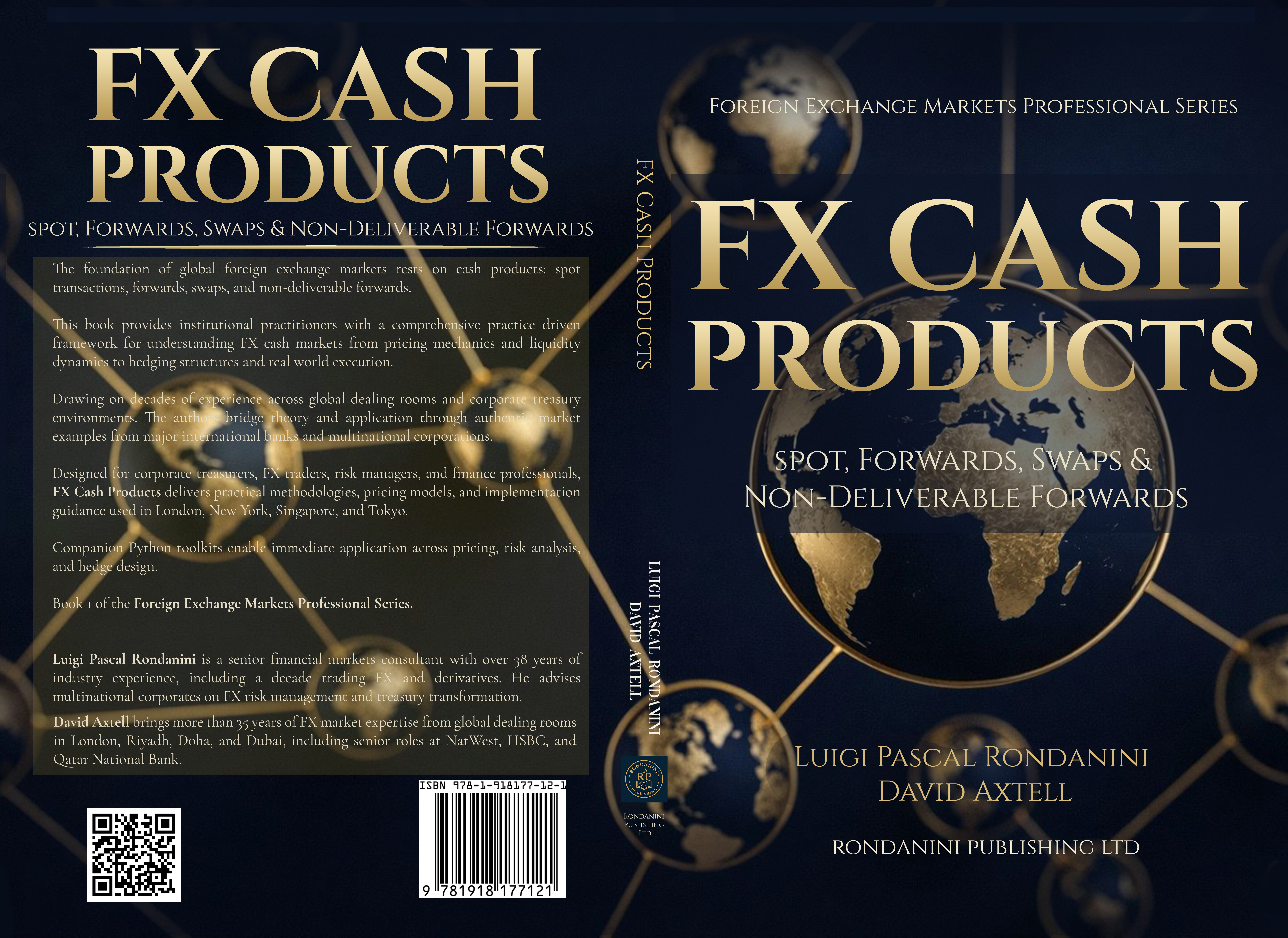
FX Cash Products: Spot, Forwards, Swaps & Non-Deliverable Forwards
Practitioner guide for treasury and markets
Luigi Pascal Rondanini · David Axtell · 2026 · Rondanini
Spot, forwards, swaps, and NDFs for corporate treasurers, traders, and risk managers—operations-first, institutionally framed.
- FX
- Treasury
- Risk management

Options, Futures, and Other Derivatives
Global edition
John C. Hull · 2021 · Pearson
The standard graduate-level derivatives text.
- Derivatives
- Risk management
- Quantitative finance

Modern Computational Finance
Scripting for Derivatives and xVA
Antoine Savine · Jesper Andreasen · 2021 · John Wiley & Sons
Second volume: building professional derivative scripting systems—cash-flow representation, branching, American Monte Carlo hooks, and how scripting supports xVA-style portfolio interrogation. Written for quant devs and library architects who must ship maintainable payoff DSLs.
- Derivatives
- Risk management
- Quantitative finance

The Man Who Solved the Market
Gregory Zuckerman · 2019 · Random House
Renaissance and quantitative investing narrative.
- Quantitative finance
- Market memoirs