
Random House · 2012
Antifragile: Things That Gain From Disorder
Level · Introductory
Editorial summary
Nassim Nicholas Taleb's 'Antifragile' is a pivotal addition to the Incerto series, which includes his previous works like 'The Black Swan'. This book positions itself uniquely on the shelf of risk management literature by introducing the concept of antifragility—entities that not only withstand shocks but thrive on them. Taleb challenges conventional wisdom by asserting that uncertainty and volatility are not merely to be avoided but embraced, providing a refreshing perspective for market professionals navigating complex environments.
Through a blend of philosophical insights and practical examples, Taleb examines how various systems—ranging from personal finance to urban planning—can be designed to be antifragile. He illustrates this through engaging anecdotes and historical references, making the content accessible to readers from diverse backgrounds. The book is structured around key themes of resilience, decision-making, and the unpredictability of life, encouraging readers to rethink their approaches to risk and uncertainty.
The mathematical and policy discussions presented are approachable, making the book suitable for an introductory audience. Taleb’s exploration of antifragility extends beyond theoretical concepts, offering practical implications for traders and strategists who must make decisions in unpredictable markets. The recurring theme of learning from failure resonates throughout, providing a framework for adapting to and benefiting from disorder.
Risk teams and treasury operations can leverage the insights from 'Antifragile' to develop strategies that not only mitigate risks but also capitalise on them. Taleb’s provocative ideas challenge readers to rethink their assumptions about stability and predictability, making this a critical read for anyone involved in financial decision-making.
While the book is rich in ideas, it is essential to approach it with an understanding that Taleb’s style is iconoclastic and may not align with traditional risk management frameworks. Readers should be prepared for a thought-provoking journey that encourages them to embrace the complexities of the modern world.
About this book
Nassim Nicholas Taleb's 'Antifragile: Things That Gain From Disorder' is a comprehensive exploration of the concept of antifragility, which refers to systems that thrive and improve when exposed to stressors, volatility, and uncertainty. The book is structured in a way that encourages readers to engage with its core ideas through a mix of theoretical discussions and practical examples. Taleb draws on a wide range of disciplines, including economics, philosophy, and psychology, to illustrate how antifragility operates in various contexts, from personal finance to societal structures.
At its core, the book challenges the traditional notions of resilience and robustness, positing that while resilient systems resist shocks, antifragile systems benefit from them. This distinction is crucial for market professionals who must navigate the unpredictable nature of financial markets. Taleb uses a variety of anecdotes and historical references to elucidate his points, making the content relatable and applicable to real-world scenarios.
Readers can expect to gain a deeper understanding of how to build antifragile systems within their own practices. The book covers topics such as decision-making under uncertainty, the limitations of forecasting, and the importance of trial and error in achieving success. Taleb's engaging writing style, combined with his philosophical insights, makes complex ideas accessible to an introductory audience, while still providing depth for those familiar with the subjects.
Competency gained from this book includes an enhanced ability to identify antifragile opportunities in financial markets and a better understanding of how to structure personal and professional practices to benefit from disorder. Taleb's insights are particularly relevant for traders, investors, and strategists who must make decisions in the face of uncertainty, providing them with a framework to thrive rather than merely survive in volatile environments.
Why it matters
'Antifragile' is essential for professionals engaged in risk management, trading, and investment, as it provides a framework for understanding how to leverage uncertainty and volatility in their workflows. By embracing the principles of antifragility, market participants can develop strategies that not only protect against adverse events but also exploit opportunities arising from chaos and disorder.
Best for
This book is best suited for traders, investors, students, and strategists who are looking to deepen their understanding of risk management and decision-making in uncertain environments. It serves as a valuable resource for those interested in behavioural finance and the psychological aspects of market dynamics.
Not ideal for
Readers seeking a strictly quantitative analysis of risk management or those who prefer traditional approaches to finance may find 'Antifragile' less aligned with their expectations. The book's philosophical underpinnings may not resonate with professionals looking for straightforward methodologies.
Key themes
risk-management|market-memoirs|behavioral-finance|uncertainty|volatility|decision-making|complex-systems|resilience|philosophy|financial-strategy
Strengths
'Antifragile' stands out for its innovative approach to understanding risk and uncertainty, offering a fresh perspective that challenges conventional wisdom. Taleb's engaging narrative style, combined with his use of diverse examples, makes complex ideas accessible and applicable to a wide audience. The book's interdisciplinary approach enriches the reader's understanding of how antifragility can be applied across various domains, from finance to personal development.
Moreover, Taleb's ability to distil profound insights into practical advice is a significant strength. The book encourages readers to rethink their strategies in the face of unpredictability, making it particularly relevant for those operating in dynamic market environments. The concept of antifragility itself is a powerful tool for professionals looking to enhance their decision-making processes and build more resilient systems.
Limitations
One limitation of 'Antifragile' is its broad philosophical scope, which may lead some readers to feel that certain concepts are not sufficiently grounded in empirical evidence. While Taleb provides numerous anecdotes and historical references, those seeking rigorous quantitative analysis may find the book lacking in statistical depth. Additionally, the iconoclastic nature of Taleb's arguments may not resonate with all practitioners, particularly those accustomed to traditional risk management frameworks. As such, readers should approach the book with an open mind and a willingness to engage with its more unconventional ideas.
Related books
Shared topics with this title.
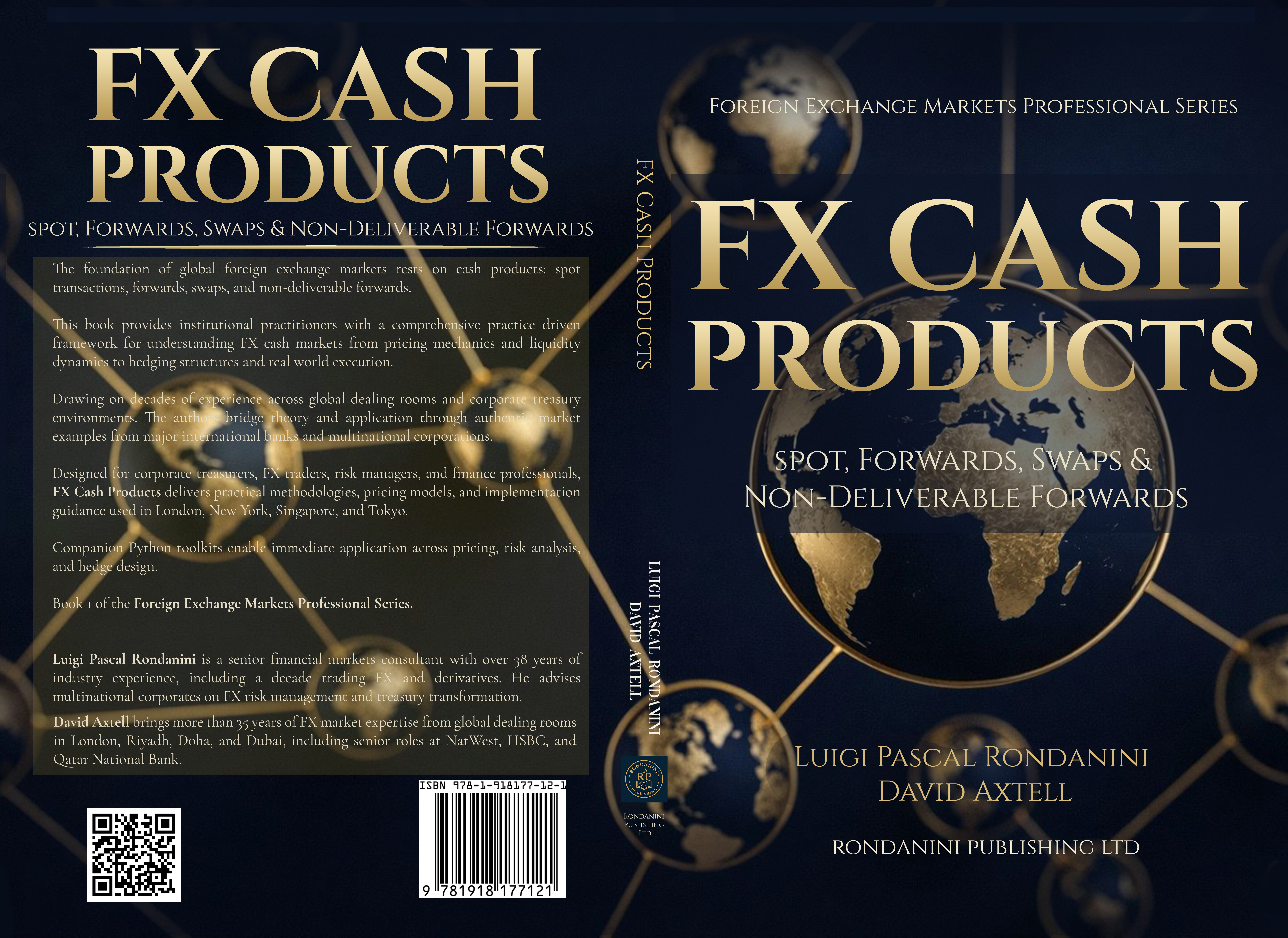
FX Cash Products: Spot, Forwards, Swaps & Non-Deliverable Forwards
Practitioner guide for treasury and markets
Luigi Pascal Rondanini · David Axtell · 2026 · Rondanini
Spot, forwards, swaps, and NDFs for corporate treasurers, traders, and risk managers—operations-first, institutionally framed.
- FX
- Treasury
- Risk management

Modern Computational Finance
Scripting for Derivatives and xVA
Antoine Savine · Jesper Andreasen · 2021 · John Wiley & Sons
Second volume: building professional derivative scripting systems—cash-flow representation, branching, American Monte Carlo hooks, and how scripting supports xVA-style portfolio interrogation. Written for quant devs and library architects who must ship maintainable payoff DSLs.
- Derivatives
- Quantitative finance
- Risk management

Options, Futures, and Other Derivatives
Global edition
John C. Hull · 2021 · Pearson
The standard graduate-level derivatives text.
- Derivatives
- Risk management
- Quantitative finance

The Man Who Solved the Market
Gregory Zuckerman · 2019 · Random House
Renaissance and quantitative investing narrative.
- Quantitative finance
- Market memoirs