
Princeton University Press · 2004
Credit Risk Modeling
Level · Institutional / advanced
Editorial summary
Credit Risk Modeling positions itself as a critical resource for professionals engaged in risk management and quantitative finance. It offers a detailed exploration of the methodologies used in credit risk assessment, making it a valuable addition to the shelves of analysts and risk managers alike. The book delves into both theoretical frameworks and practical applications, ensuring that readers can effectively navigate the intricacies of credit portfolios and default modelling.
The text is structured to guide readers through various parts of credit risk modelling, including the examination of default probabilities, recovery rates, and the dynamics of credit portfolios. Lando employs a rigorous mathematical approach, making the content suitable for those with a solid grounding in quantitative finance. The book also addresses the empirical properties of credit-related time series, providing readers with a robust understanding of how these factors influence risk management strategies.
Risk teams and treasury operations will find this book particularly useful as it highlights the importance of integrating theoretical insights with practical applications. The methodologies discussed are applicable to real-world scenarios, enhancing the reader's ability to implement effective credit risk strategies. Furthermore, the text encourages critical thinking about current practices in credit risk management, prompting readers to consider improvements and adaptations in their approaches.
While the book is comprehensive, it primarily targets those with a background in finance or risk management, which may limit its accessibility to a broader audience. However, for those within the field, it serves as an indispensable guide to understanding and managing credit risk in a complex financial landscape.
Overall, Credit Risk Modeling is a vital resource for professionals looking to deepen their understanding of credit risk and enhance their analytical capabilities in this domain.
About this book
Credit Risk Modeling is structured to provide readers with a thorough understanding of the theoretical underpinnings and practical applications of credit risk assessment. The book begins with foundational concepts in credit risk, exploring the various types of credit exposures and the significance of default probabilities. Lando meticulously discusses the methodologies employed in modelling credit portfolios, ensuring that readers grasp the essential quantitative techniques necessary for effective risk management.
The text covers critical topics such as the empirical properties of credit-related time series, including default probabilities and recoveries, which are pivotal for accurate risk measurement. Lando also examines the structural and reduced-form approaches to pricing defaultable securities, offering a comparative analysis that underscores their respective strengths and weaknesses. This dual approach allows readers to appreciate the nuances of credit risk modelling and the implications for financial institutions.
In addition to theoretical discussions, the book provides practical insights into the pricing of credit derivatives, such as credit swaps and collateralized debt obligations. By integrating empirical data with theoretical models, Lando equips readers with the tools necessary to assess and manage credit risk effectively. The text also addresses the evolving landscape of credit risk management, encouraging readers to consider enhancements to current practices that may better position financial institutions for future challenges.
Competency gained from this book includes a robust understanding of credit risk modelling techniques, the ability to apply quantitative methods in real-world scenarios, and insights into the complexities of credit derivatives. Readers will emerge with the skills necessary to navigate the challenges of credit risk management, making informed decisions that align with regulatory requirements and market dynamics.
Why it matters
Understanding credit risk is crucial for maintaining the stability of financial institutions and ensuring compliance with regulatory standards. This book equips professionals with the necessary tools to assess risk limits, price defaultable securities, and manage credit portfolios effectively. By applying the methodologies discussed, risk managers can enhance their strategies and adapt to the evolving financial landscape, ultimately safeguarding their institutions against potential losses.
Best for
Credit Risk Modeling is best suited for analysts and risk managers seeking to deepen their understanding of credit risk and quantitative finance. It is also valuable for academic researchers and students focusing on risk management and credit analysis.
Not ideal for
This text may not be ideal for beginners in finance or those without a quantitative background, as it assumes a certain level of familiarity with mathematical concepts and risk management principles. Additionally, practitioners looking for a broad overview of credit risk without in-depth technical analysis may find it less suitable.
Key themes
credit-risk|quantitative-finance|risk-management|default-modelling|credit-portfolios|credit-derivatives|empirical-analysis|financial-institutions|market-dynamics|regulatory-compliance
Strengths
One of the key strengths of Credit Risk Modeling is its comprehensive approach to both the theoretical and practical aspects of credit risk assessment. Lando's integration of empirical data with theoretical models provides readers with a well-rounded perspective on the complexities of credit risk. The book's detailed examination of various methodologies, including structural and reduced-form approaches, equips readers with the knowledge to critically assess different modelling techniques. Furthermore, the focus on real-world applications ensures that professionals can directly apply the insights gained to their work in risk management and credit analysis.
Limitations
Despite its strengths, the book may present challenges for readers without a solid foundation in quantitative finance. The mathematical rigor and technical detail may be overwhelming for those new to the field, limiting its accessibility. Additionally, while the book covers a wide range of topics related to credit risk, it may not delve deeply into specific regulatory frameworks or the latest developments in credit risk management practices, which could be a drawback for practitioners seeking the most current insights.
Related books
Shared topics with this title.
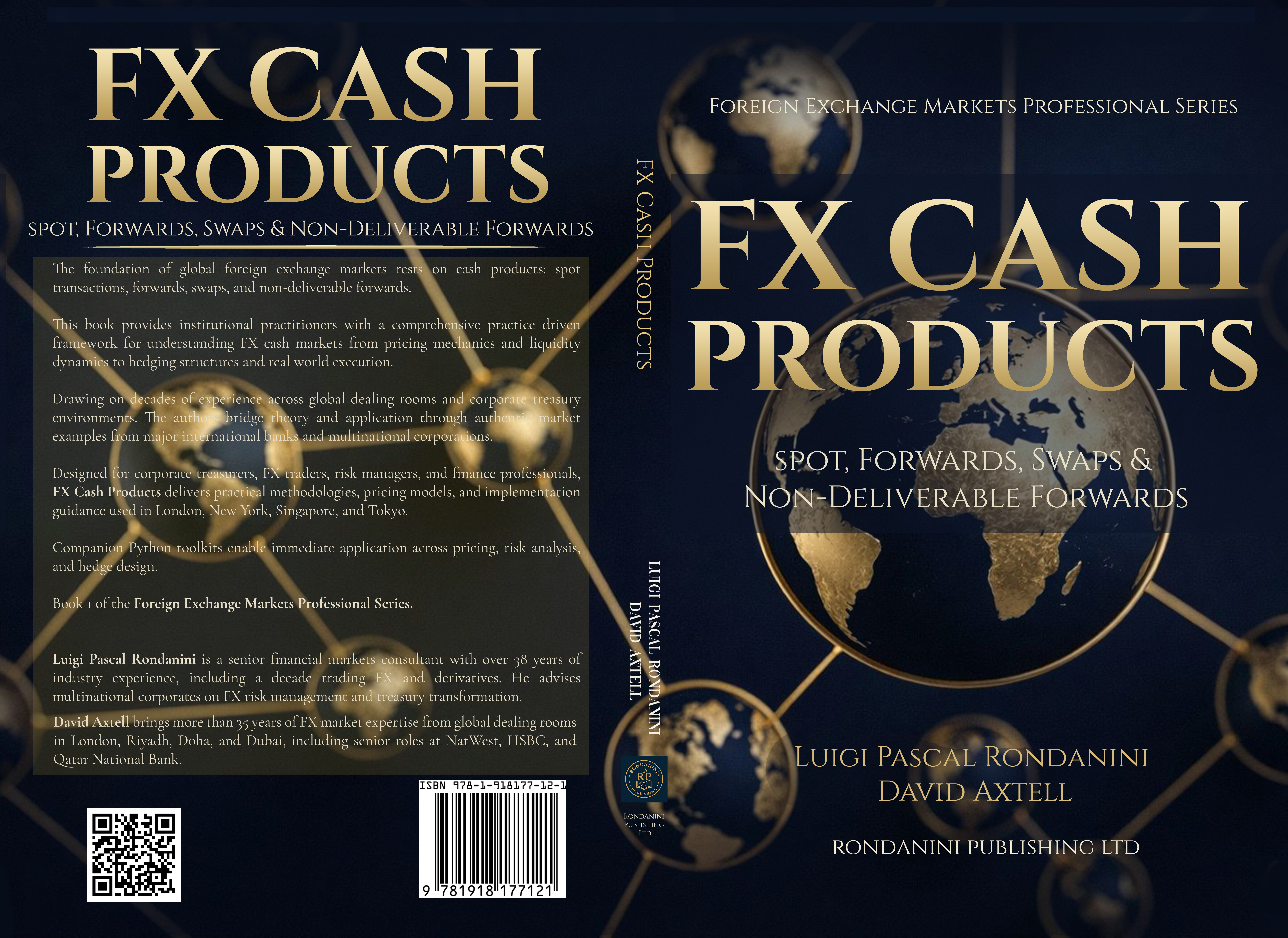
FX Cash Products: Spot, Forwards, Swaps & Non-Deliverable Forwards
Practitioner guide for treasury and markets
Luigi Pascal Rondanini · David Axtell · 2026 · Rondanini
Spot, forwards, swaps, and NDFs for corporate treasurers, traders, and risk managers—operations-first, institutionally framed.
- FX
- Treasury
- Risk management

Modern Computational Finance
Scripting for Derivatives and xVA
Antoine Savine · Jesper Andreasen · 2021 · John Wiley & Sons
Second volume: building professional derivative scripting systems—cash-flow representation, branching, American Monte Carlo hooks, and how scripting supports xVA-style portfolio interrogation. Written for quant devs and library architects who must ship maintainable payoff DSLs.
- Derivatives
- Quantitative finance
- Risk management

Options, Futures, and Other Derivatives
Global edition
John C. Hull · 2021 · Pearson
The standard graduate-level derivatives text.
- Derivatives
- Risk management
- Quantitative finance

High Performance Computing: Modern Systems and Applications
Michael Gorelick · Iman Ozsvald · 2019 · O Reilly
This comprehensive volume delves into high-performance computing (HPC) systems and their applications, particularly in quantitative finance and technology. It covers modern architectures, programming models, and performance optimization techniques essential for practitioners in the field.
- Technology
- Quantitative finance